


.png)


A hospital's integration dashboard shows every interface green.
The HL7v2 feed from a 15-year-old EHR delivers ADT messages on schedule, the new FHIR endpoint returns schema-valid JSON, and last month's vendor demo showed an LLM turning discharge letters into tidy Condition resources in seconds.
Then a care-management application pulls one patient's record and finds two birth dates, no smoking status, and a diagnosis coded against last year's ICD-10-CM release. Every message arrived on time. The data still disagrees with itself.
Can AI middleware fix this? For a defined set of problems, yes.
AI middleware can translate, normalize, extract, and reconcile information already present in source systems. It cannot manufacture a clinical fact the source system never captured. Recent studies report strong results for AI-assisted harmonization, clinical-text extraction, and record linkage, and the evidence for fully autonomous, clinical-grade interoperability is still thin.
The six problems below show where the AI layer earns its place, which controls stay deterministic, and when the fix belongs upstream in the EHR itself.
Why does EHR interoperability still break when most hospitals already have APIs?
Most EHR interoperability failures happen after the API call succeeds, because exposing an API and delivering consistently interpretable data are separate achievements.
ONC's February 2026 data brief, built on the 2024 AHA IT Supplement, found about 90% of U.S. hospitals offered patient access through an API, and 71% used a standards-based API for that purpose.
Exchange with third-party technology relies far less on standards-based APIs, as the ONC figures below show.
Source: ONC, 2026, based on the 2024 AHA IT Supplement.
For exchange with third-party technology, hospitals still rely more on proprietary APIs, HL7 interfaces, and other non-standard methods than on standards-based APIs. Each interface brings its own field names, local codes, and assumptions.
An EHR can offer an API and still need heavy translation before another application can use its data. AI middleware is built for that translation work.
What is AI middleware for EHR interoperability?
AI middleware for EHR interoperability is an integration layer in which models propose field mappings, extract structured data from clinical text, and score patient matches, and in which deterministic services validate every AI output before a downstream application consumes it.
The model is one component inside the integration layer. It does not replace the interface engine, the terminology server, or the master patient index.
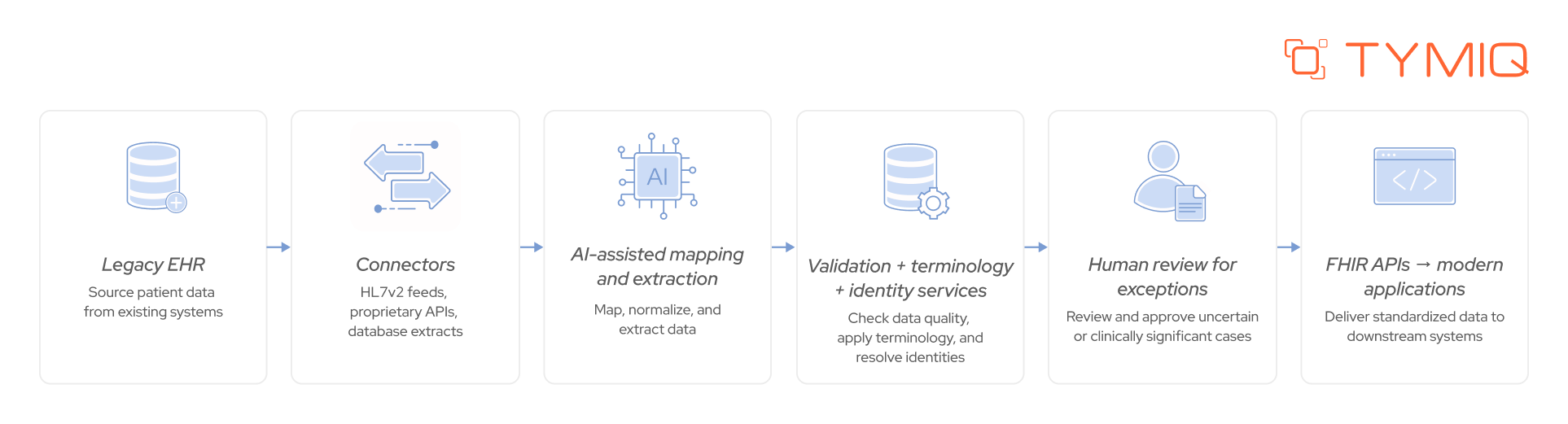
The architecture holds up because each layer has one job. Keeping AI outputs separate from validation gives every transformation an owner, a version, and an audit trail.
Each record can also carry its provenance, meaning which model touched it, which source document it came from, and its review status. Here is how the responsibilities split across layers:
Adoption figures explain the urgency.
Deloitte's 2026 Global Health Care Outlook surveyed 180 C-suite executives from large health systems in Australia, Canada, Germany, the Netherlands, the UK, and the US. About 30% reported operating generative or agentic AI at scale in selected areas, and only 2% reported enterprise-wide deployment.
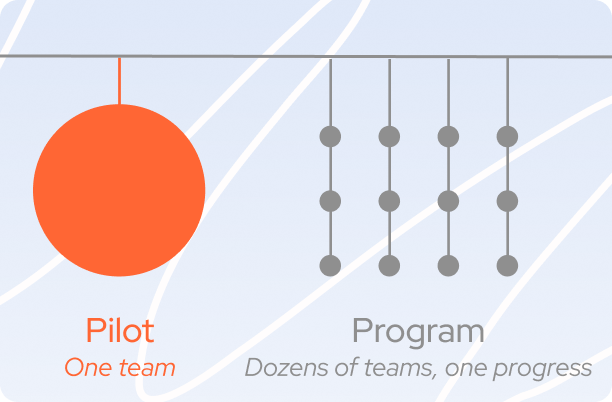
Hand-curated inputs can carry a pilot, and production workloads spanning dozens of interfaces need automated validation and provenance, so scaling past pilots forces organizations to build the integration layer first.
Which interoperability problems can AI middleware handle?
Six problems keep showing up, and in every one the data already exists somewhere in the source systems.
Short on time? Here's the quick version:
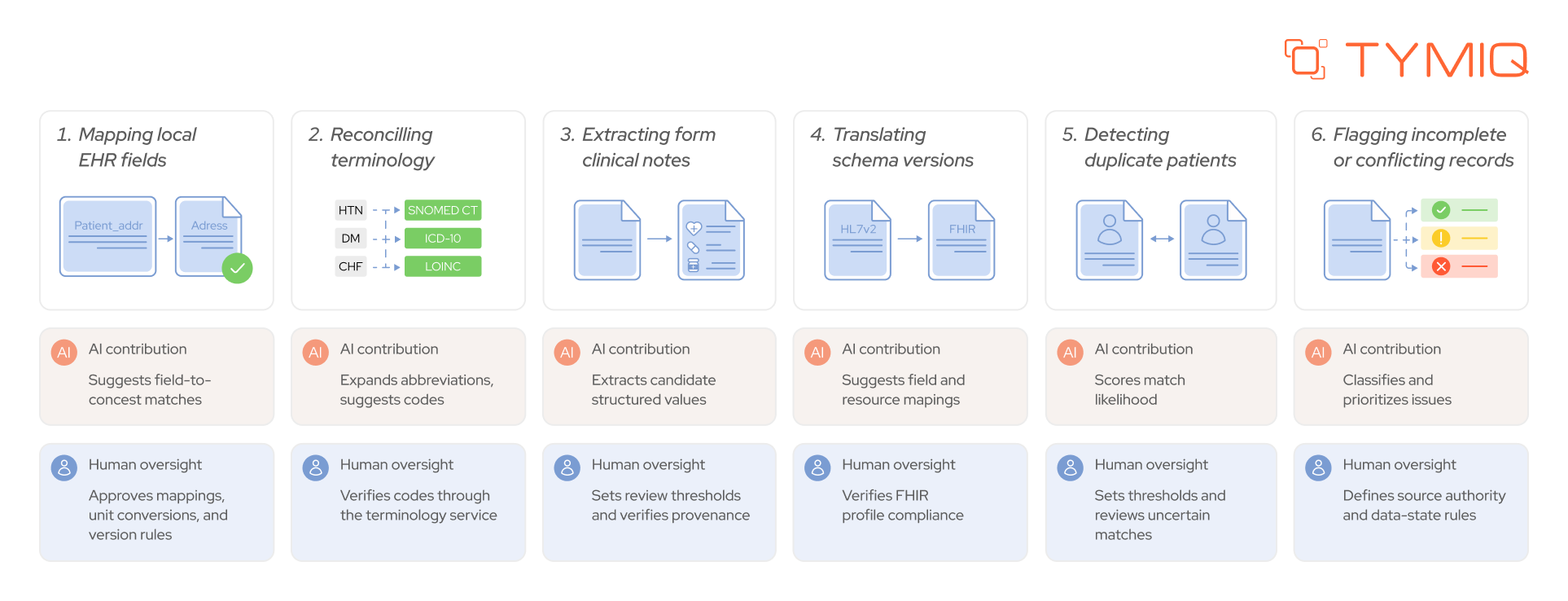
Now for the details, with the payloads, configs, and study numbers behind each one.
1. Mapping local EHR fields to standardized concepts
Legacy EHRs store data under local names like PT_WT, SMK_STAT, or DX1, often with outdated code versions and undocumented local meanings.
A modern application can't use those fields until each one maps to a standard concept. AI speeds this up by reading the field name, sample values, and neighboring columns, then proposing a match. Every proposal still needs validation and version tracking before it goes live.
A 2026 study in npj Digital Medicine tested this approach across 31 biomedical datasets.
Experts found 94% of generated metadata fields needed no revision, and the system mapped 32.4% of previously unseen headers to existing common data elements. The pipeline paired LLM output with weighted field matching and expert review.
In practice, here's what an AI proposal looks like for three typical legacy fields, and the rule-based check each one has to pass before approval:
The weight row shows why a concept-level match needs a second check. A semantic match between PT_WT and body weight is correct at the concept level but it is clinically dangerous if the pipeline skips the unit conversion.
Semantic similarity is evidence for a mapping. Clinical validity comes from the rules and reviewers downstream.
2. Reconciling terminology variations
Terminology reconciliation resolves abbreviations, synonyms, and code-system versions into governed standard codes, and a terminology service, never the AI model, holds final authority over which code is valid.
Two short chains illustrate the work:
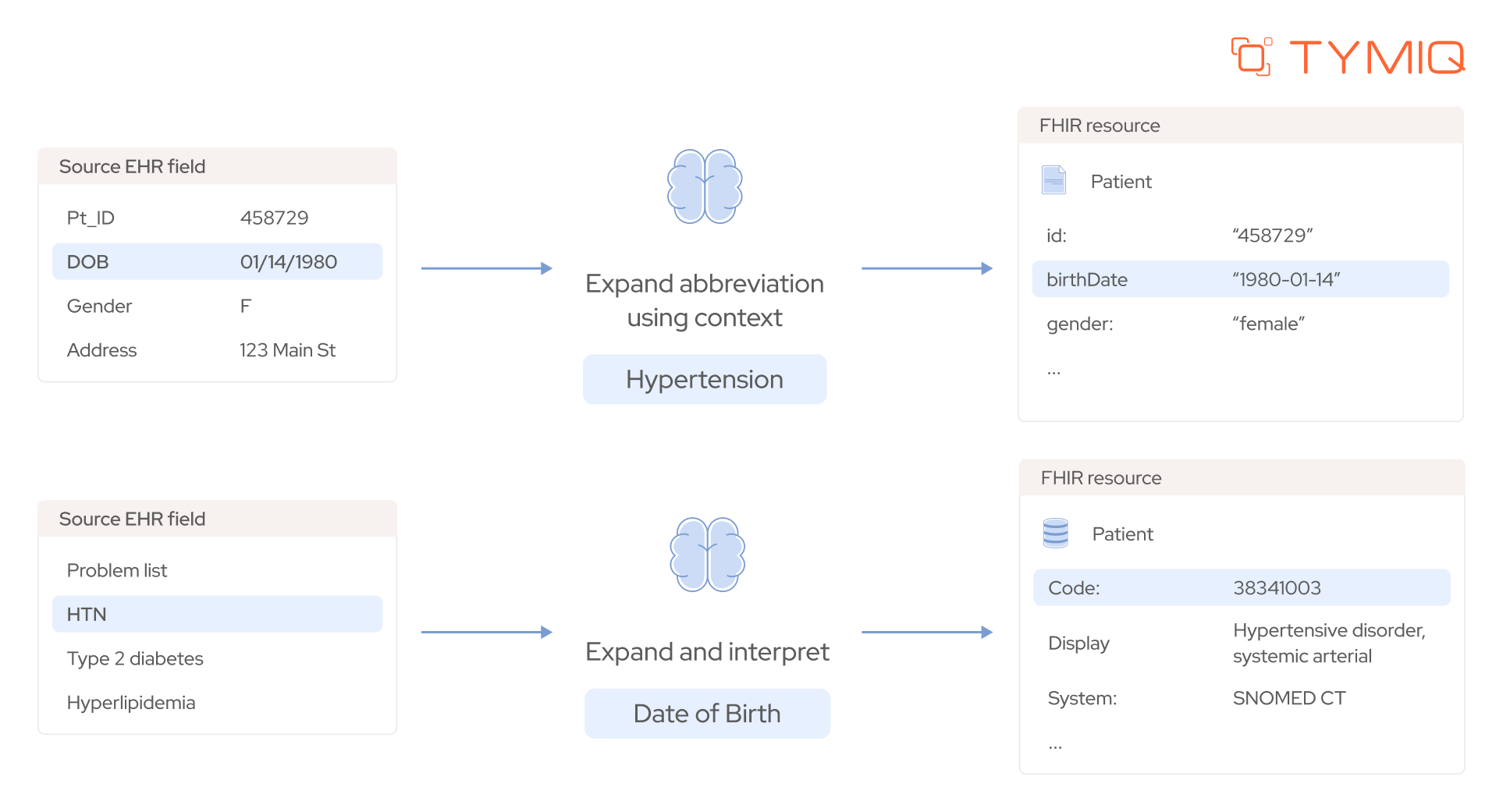
Language models handle the first hop well, since “HTN” can be expanded from context. The second hop needs an exact code from a specific code system and version.
Versions change often. ONC's USCDI v7, released in July 2026, pins specific vocabulary versions such as LOINC 2.82 and the March 2026 SNOMED CT U.S. Edition. ICD-10-CM gets a new release every October 1, plus mid-year updates like the one on April 1, 2026. A mapping approved last year can point at a code whose validity has since changed.
Every code the AI layer proposes should therefore pass through a terminology service, such as ONC's Cartos or an in-house server, before approval:
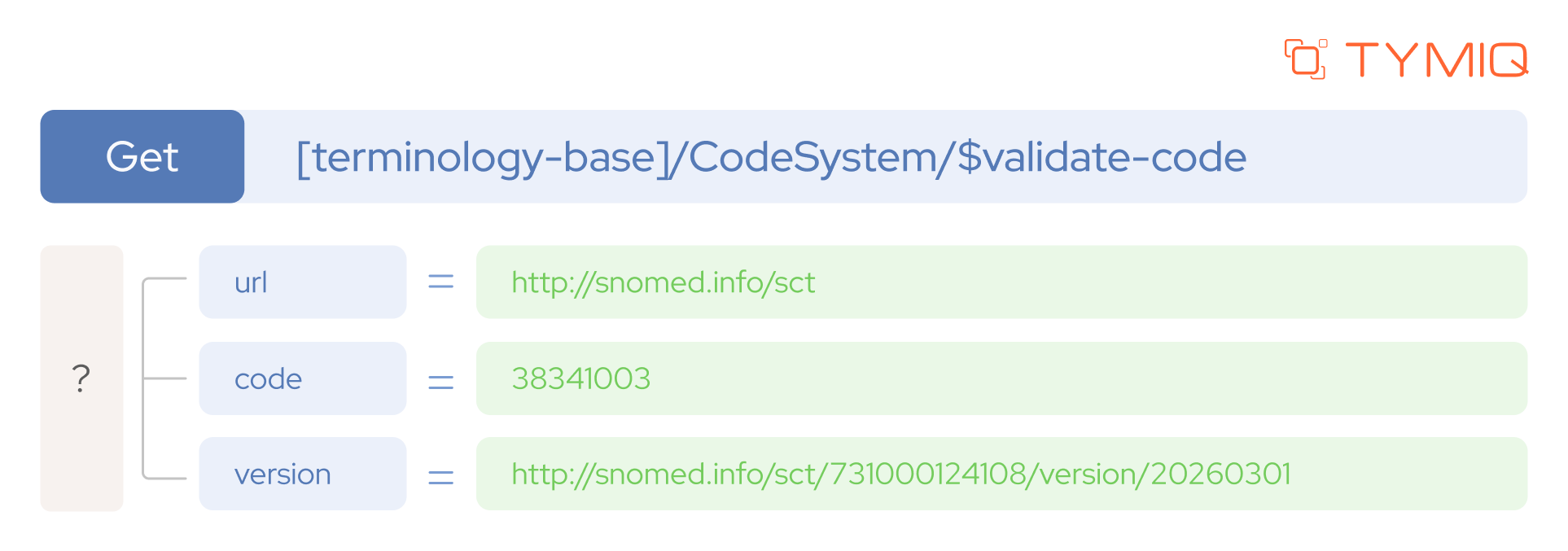
A code that fails validation or belongs to a retired version is sent back for review, so only codes the terminology service accepts reach the approved mapping table.
3. Extracting structured information from clinical notes
Clinical-note extraction is one of the clearest AI middleware use cases, provided every extracted value enters downstream systems as a reviewable candidate with provenance attached.
A 2026 proof-of-concept study published in JMIR evaluated LLM extraction from real-world discharge letters, and physician reviewers scored case-level correctness by category:
The 31.7-point spread between medications and procedures matters more than any blended average. Medication mentions tend to follow a predictable form of drug, dose, route, and frequency, and procedure details scatter across narrative text, dates, and history sections.
A team that tunes review thresholds on medication accuracy will overestimate how safely the same pipeline handles procedures, so thresholds belong at the category level.
Take a note from a legacy EHR: “Patient reports occasional shortness of breath when climbing stairs. No symptoms at rest.” A modern application wants structured fields for the symptom, its trigger, and its frequency. The AI layer turns the note into a candidate Observation, and the middleware attaches a Provenance record linking it to the model and the source document, as HL7's AI Transparency on FHIR implementation guide describes.
The core of that record fits in a few lines:
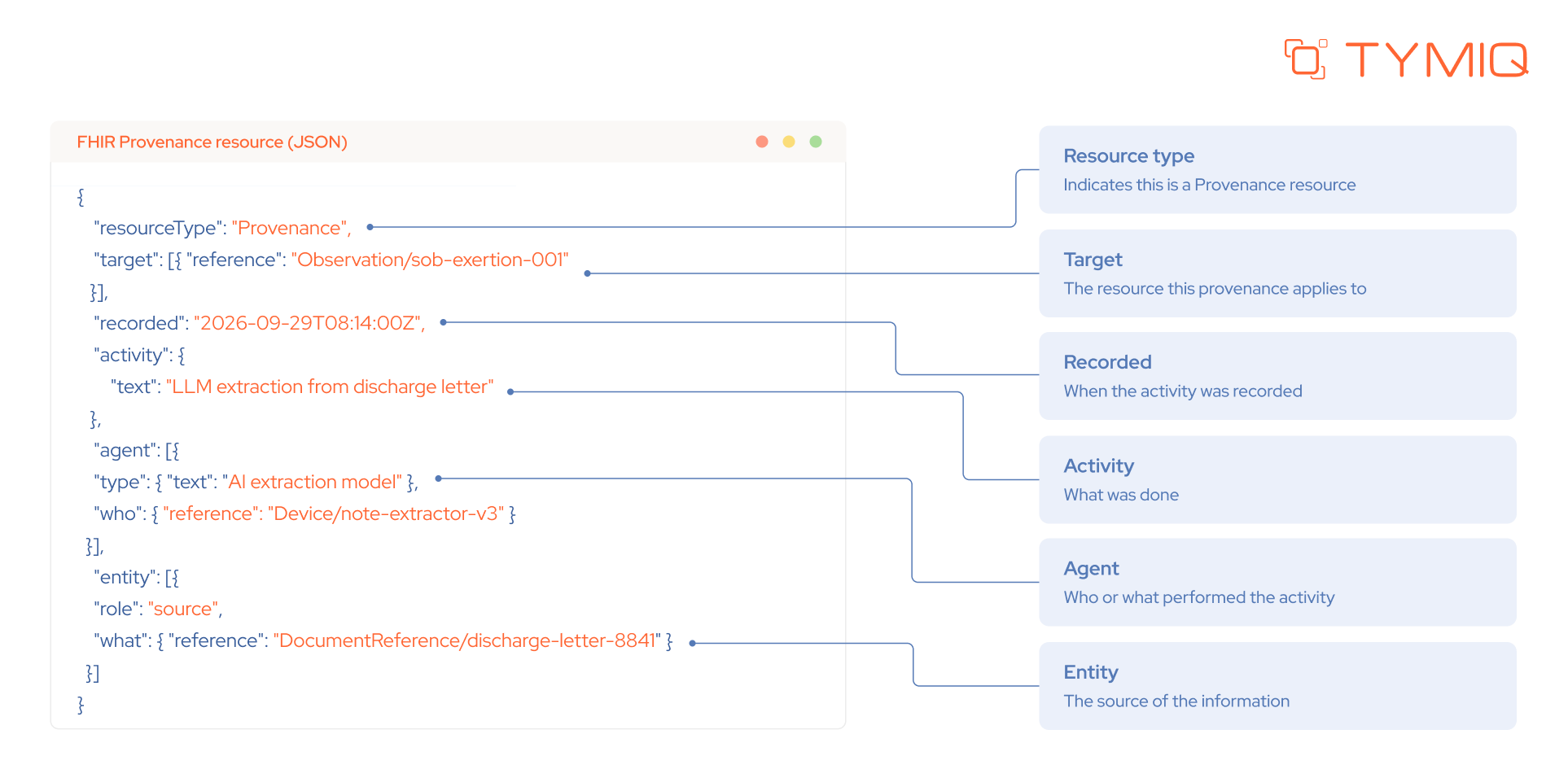

Treat every extracted value as a draft. Keep it at 'preliminary' status, link it to the note it came from, and let a clinical reviewer promote it to 'final.' Teams that skip this step end up with clinical data nobody can trace back to a source.
4. Translating between schema versions
A pipeline can output valid FHIR JSON and still get the resource, profile, code, or meaning wrong, because format conversion and semantic conversion are separate jobs. According to ONC's FHIR overview, FHIR resources define data elements, constraints, and relationships for exchangeable patient records. Those definitions also change between versions. HL7 Europe published new implementation guides in January 2026 covering both FHIR R4 and R5, with extensions for the European Health Data Space.
A version difference shows the risk. In FHIR R4, MedicationRequest carries the drug as a choice element, medicationCodeableConcept or medicationReference. FHIR R5 replaces both with a single CodeableReference element named medication.
Catching errors like this depends on a clear split of duties. Catching errors like this depends on a clear split of duties. AI speeds up the analysis work, and rule-based checks cover every message before it ships:
AI shortens the analysis work in the left column, which is where interface projects burn most of their calendar. Every item in the right column runs on each message in production, and failures land in an error queue for an integration engineer.
5. Detecting near-duplicate patient records
Machine learning can score the likelihood of two records belonging to the same patient, and confidence thresholds plus human review decide which records get linked.
ONC defines patient matching as linking one patient's data across systems to create a more complete record, with name, date of birth, phone number, and address among the core demographic inputs.
A person sees one patient here. An exact-match rule sees two, because only the birth date and phone number match character for character.
A machine learning model handles the comparison in four steps:
- It normalizes each field first, expanding "St." to "Street," setting middle initials aside, and standardizing date and phone formats.
- It scores each field for similarity, allowing near matches on names and addresses and requiring exact matches on birth dates.
- It weights fields by how much they reveal, so a shared birth date and phone number count for more than a common surname.
- It combines the field scores into a single match probability for the pair.
The model then routes each pair by confidence, linking high-confidence matches automatically, sending medium-confidence pairs to human review, and keeping low-confidence pairs separate.
6. Identifying inconsistent demographic and clinical fields
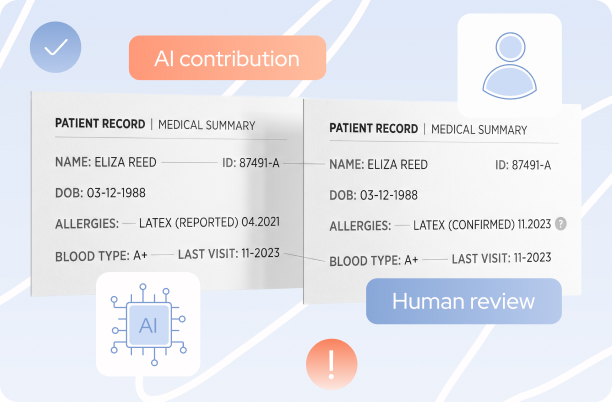
Once data moves between systems, values stop agreeing: a birth date entered differently at registration and in the lab, an allergy updated in one EHR only, an address that changed between visits. AI middleware can find these conflicts and rank them by clinical risk, and field-level authority rules decide which value wins.
The operational cost is real. ONC's 2026 analysis of electronic public health reporting found 81% of hospitals hit at least one reporting challenge. Technical complexity affected 55% of hospitals, cost affected 33%, and difficulty extracting information from the EHR affected 25%.
The AI layer pays off in triage. A model can tell a transposed digit from a different person, recognize "PCN" and "Penicillin" as the same allergen, and push clinically significant conflicts to the front of the review queue. The authority table decides the outcome, and the middleware flags or reconciles without ever inventing a replacement value.
7. Flagging incomplete or conflicting records
When a source system never recorded a clinical fact, middleware has nothing authoritative to transform. The CDC/CMS FY2026 ICD-10-CM guidelines apply the same rule to coding: without sufficient documentation, accurate coding is impossible. AI can predict a missing value, but a prediction is not documentation.
The unsafe output looks like clean data to every downstream consumer. A risk model, a quality measure, or a clinician scanning a summary would read it as documented fact.
Middleware prevents this by assigning every value an explicit state:
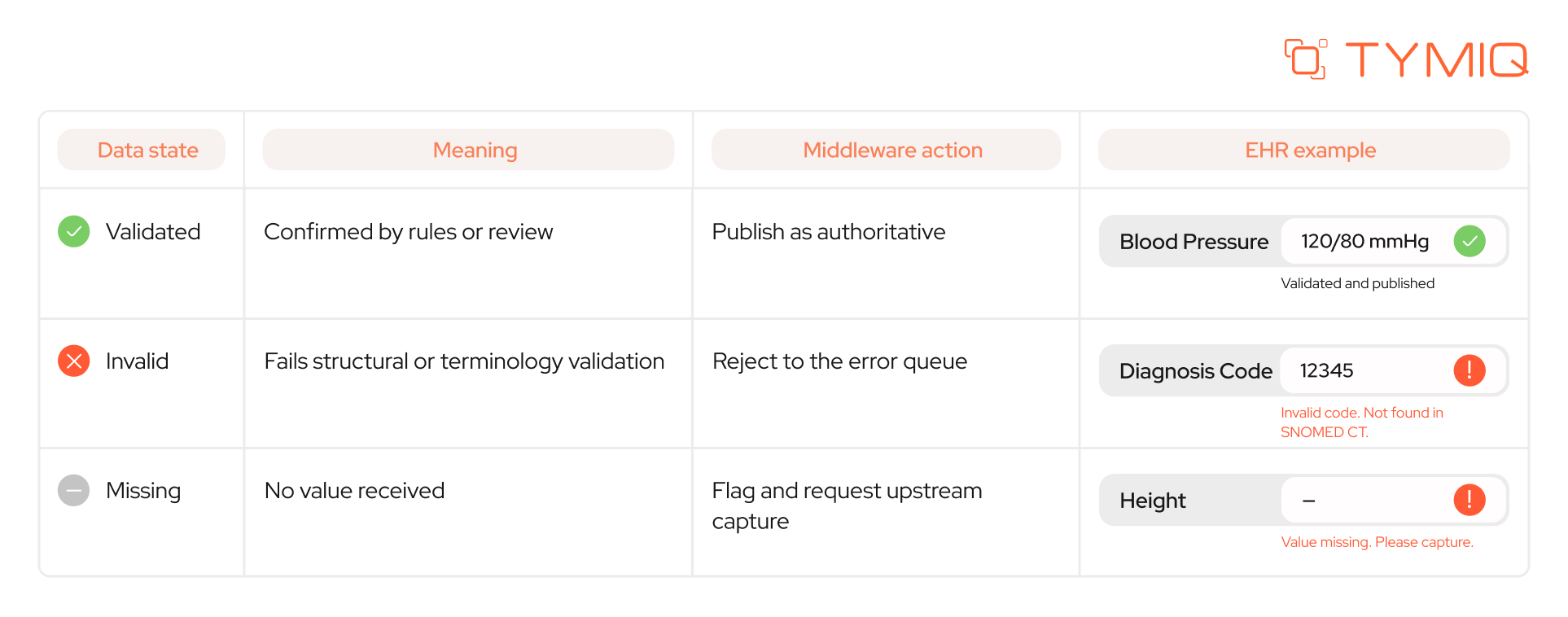
AI can help classify records into these states and prioritize the review queue. Deterministic rules decide what happens to each state, and consuming applications decide which states they accept.
Why does AI need an integration layer around the EHR?
Sending EHR data straight through an LLM to a clinician skips the provenance, validation, and review controls U.S. regulators now expect around clinical algorithms.
ONC's HTI-1 final rule requires certified health IT to give clinical users enough information about AI and predictive algorithms to judge their fairness, validity, effectiveness, and safety. The rule's reach is wide, since certified health IT covers more than 96% of U.S. hospitals and 78% of office-based physicians.
The FDA's January 2026 Clinical Decision Support Software guidance focuses on a related test: whether clinicians can independently review the basis for a recommendation, including its input data, data quality, and validation.
To meet both expectations, an architecture needs:
- Provenance showing which source and which model produced each value
- Validation of every AI output against schemas and terminology before release
- Versioned mappings, so any past output traces back to the rules in force at the time
- A defined review path for uncertain or clinically significant results
A direct EHR-to-LLM chain offers none of these controls. The LLM belongs inside the integration layer instead, with logged and versioned steps on both sides, where an auditor can inspect it like any other component.
Where should an integration team start?
Start with one data flow where the source data exists, and the cost of failure is measurable, and add AI only at steps with a validator behind them.
A narrow first flow gives the team real error rates to calibrate against before the architecture spreads to other interfaces.
- Inventory every interface feeding the target application and record its method: standards-based API, proprietary API, HL7v2 feed, or file extract.
- Stand up a terminology service before any AI mapping work, so every proposed code meets a validator on arrival.
- Define the data-state labels (source, extracted, inferred, validated, missing) in your FHIR profiles before the first extraction model ships.
- Set review thresholds per category from a manually reviewed sample, following the designs of the JAMIA and JMIR studies.
- Track the weekly share of records reaching human review, since a rising rate signals mapping drift or an upstream capture problem.
Each step produces an artifact a reviewer or auditor can inspect: an interface inventory, a terminology validation log, a profile with explicit state labels, a calibration sample, a review-rate trend. Together they convert AI middleware from a demo into infrastructure a clinical safety committee can sign off on.
What does this mean for your EHR integration roadmap?
AI middleware pays off when the data exists but doesn't line up across systems. When a fact was never recorded or can't leave the EHR, the budget belongs in the source system.
To audit what you already run, trace any output field back to its source. A validated mapping and a source document mean the architecture works. A model's guess stored as fact means it doesn't.
TYMIQ's AI engineering team helps healthcare organizations and health-tech companies draw that line early, before a source-system problem gets assigned to middleware.


.svg)


