


.NET framework to .NET core migration services for real estate
Is your real estate platform still running on legacy .NET Framework? TYMIQ offers specialized migration services tailored to the unique demands of the real estate industry. We aim to help you seamlessly transition to .NET Core and unlock enhanced performance, cross-platform support, and modern development capabilities built for property management, listing portals, CRM systems, and beyond.
Not ready for a full migration?
Many teams start with a fixed-price Discovery Phase before committing to implementation.
- Architecture review
- Dependency analysis
- Migration risks and blockers
- Modernization roadmap
Why is the real estate industry in the middle of a .NET migration wave?
Real estate is experiencing a technology inflection point. Across the industry, from property management companies and listing portals to investment platforms and PropTech startups, teams are discovering that their .NET Framework-based systems are becoming the single biggest obstacle to growth.
When is .NET Core migration the right move for your business?
Migrating from .NET Framework to .NET Core isn't just a technical upgrade for real estate companies; it's a strategic business decision. Here are the key scenarios where the transition delivers real value:
If your team relies on a monolithic system that's difficult to update, slow to respond, or incompatible with modern integrations, migrating to .NET Core modernizes your infrastructure with a modular, maintainable codebase.
Many real estate platforms are locked into expensive Windows Server environments. Migrating to .NET Core unlocks Linux hosting and containerized deployments, resulting in significantly reduced infrastructure costs.
Whether you're building a new listing portal, a tenant management app, or a real-time auction platform, .NET Core enables rapid adoption of cloud-native architectures, microservices, and DevOps practices.
Real estate businesses handle sensitive financial and personal data. .NET Core provides modern security standards and regular updates to help you comply with GDPR, CCPA, and other applicable data protection regulations.
Seasonal spikes, end-of-quarter closings, and hot market periods require scalable infrastructure. .NET Core's architecture handles high transaction volumes and concurrent users more efficiently than legacy .NET Framework apps.
AI-powered property recommendations, IoT-enabled smart building management, and machine learning-driven pricing models all require a modern runtime. .NET Core positions your platform to adopt these capabilities without legacy constraints.
%20-%20How%20to%20move%20from%20.NET%20Framework%20to%20.NET%20Core%20in%20a%20few%20steps_%20Migration%20guide.webp)
The cost estimate for .NET Framework to .NET Core migration in real estate
During the initial conversation with each prospective client, our migration experts attentively assess your real estate platform and provide a ROM estimate of the effort and costs involved. Below are the key factors we consider, which are especially relevant to real estate applications:
Monolithic real estate platforms (e.g., all-in-one PMS or CRM systems) require more effort than modular or microservices-based systems.
Complex business logic, such as lease management, commission calculations, multi-currency transactions, or compliance workflows, increases migration effort.
Larger codebases with multiple modules: listings, search, user management, and reporting require more time to review, refactor, and test.
Real estate platforms often rely on MLS feeds, Salesforce CRM, DocuSign, Stripe, Google Maps API, and other services. Compatibility with .NET Core must be verified and, if needed, re-implemented.
Migration of data access layers, especially for property databases with complex schemas and large datasets, requires careful planning (e.g., Entity Framework migration)
APIs used for listing syndication, tenant portals, or document management may require reworking for .NET Core compatibility.
APIs used for listing syndication, tenant portals, or document management may require reworking for .NET Core compatibility.
TYMIQ reengineering methodology visualization
Below is a timeline diagram showing the key deliverables of TYMIQ’s .NET reengineering lifecycle. Under the diagram, you'll find a complete step-by-step guide that explains each phase in detail, from analysis to deployment.
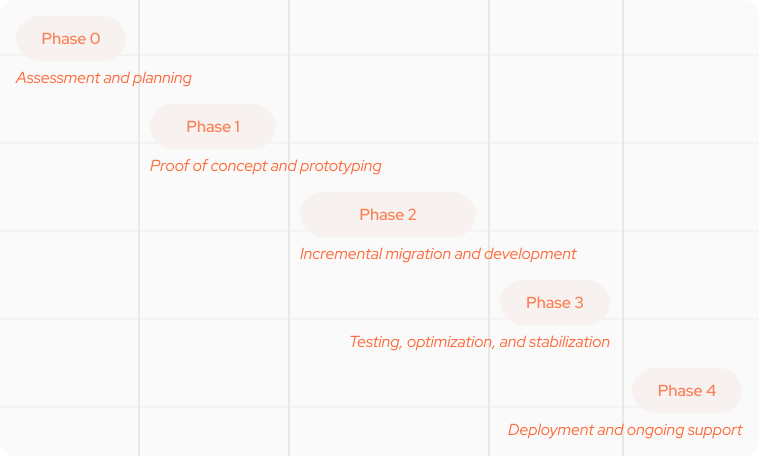
What we actually cover (the agenda)
Below is a timeline diagram showing the key deliverables of TYMIQ’s .NET reengineering lifecycle. Under the diagram, you'll find a complete step-by-step guide that explains each phase in detail, from analysis to deployment.
We assess your real estate platform by reviewing the codebase, integrations, and business documentation to understand the scope and requirements.
We decompose the application into logical modules (e.g., listings, search, CRM, reporting, document management), define the target architecture, and finalize technology decisions.
We assemble a team combining domain experts familiar with real estate workflows and engineers skilled in .NET Core.
a) At the very start, we select a small, low-risk module to test the migration to .NET Core and the chosen frontend framework. b) We build a prototype using the target architecture and present it to stakeholders for feedback and alignment with business objectives. c) Migration strategy is refined based on PoC results.
a) We validate the PoC for code quality, security, and performance. b) Presenting the PoC to stakeholders for feedback and alignment with business goals. c) Refining the migration strategy or design based on the feedback.
We break it into manageable modules (e.g., authentication, data access, business processes, notifications, business rules, and reporting) and prioritize migration based on technical dependencies, complexity, and risk.
We engage developers with domain expertise and knowledge of the codebase to strengthen the team.
We migrate modules one by one with defined requirements and goals.
a) We set up pipelines for automated builds, testing, and deployments with version control integration. b) Implementing the best DevOps practices, including infrastructure as code, automated testing, and continuous monitoring. c) Developing automated test suites for unit, integration, and regression testing.
a) We validate functional requirements with unit, integration, and user acceptance testing (UAT). b) Conducting performance and load testing to ensure benchmarks are met and scalability. c) Performing security assessments, including penetration testing and vulnerability scanning.
a) We improve performance by reviewing and optimizing the codebase and database queries. b) Implementing caching strategies (e.g., Redis caching) and use monitoring tools (e.g., Application Insights) to identify bottlenecks and enhance application efficiency.
a) We fix bugs and optimize system stability. b) Executing the data migration plan, ensuring data integrity through thorough validation.
a) We define the deployment strategy (e.g., blue-green deployment) to minimize downtime and risk. b) Setting up the target infrastructure (e.g., cloud, on-premises) and configure it (e.g., load balancers, servers). c) Implementing continuous monitoring and alerting with tools like Application Insights or Grafana. d) Establishing a patching and update process for applications and infrastructure.
a) We deploy the solution to a production-like environment for final validation. b) Monitoring closely, gather feedback, and address any issues.
a) We gradually expand deployment to the entire user base. b) Providing post-deployment support for issue resolution.
a) We define the deployment strategy (e.g., blue-green deployment) to minimize downtime and risk. b) Setting up the target infrastructure (e.g., cloud, on-premises) and configure it (e.g., load balancers, servers). c) Implementing continuous monitoring and alerting with tools like Application Insights or Grafana. d) Establishing a patching and update process for applications and infrastructure.
a) We deploy the solution to a production-like environment for final validation. b) Monitoring closely, gather feedback, and address any issues.
a) We gradually expand deployment to the entire user base. b) Providing post-deployment support for issue resolution.
Ready to modernize your real estate platform? Book a consultation with TYMIQ to learn how we can make your migration smooth and risk-free.
Request a consultationReal estate .NET Core migration: Tailored solutions for property business
Real estate is a data-intensive, relationship-driven industry with unique technical demands. TYMIQ's migration services are tailored to the specific systems and workflows that power your business:
.svg)
Modernize tenant management, lease tracking, maintenance request workflows, and financial reporting by migrating your PMS to .NET Core, enabling faster processing, better scalability, and seamless cloud deployment.

Deliver faster property search, real-time inventory updates, and responsive cross-device experiences. .NET Core's performance improvements and cross-platform support make it ideal for high-traffic listing platforms.

Migrate agent and broker CRM systems to .NET Core to improve integration with third-party tools, automate lead nurturing workflows, and enhance data security for client records.

Modernize document-heavy workflows: lease agreements, purchase contracts, compliance filings with .NET Core's improved API support and integration capabilities for tools like DocuSign and Adobe Sign.
Enable IoT integrations for energy management, access control, and smart facility monitoring by migrating to .NET Core's modern runtime, which provides better IoT framework support.

Migrate financial modeling, ROI calculation, and portfolio reporting tools to .NET Core for improved performance, advanced analytics integration, and regulatory compliance.
Our featured .NET migration projects
We have partnered with organizations across various industries to migrate their legacy applications to .NET Core. Leveraging our expertise, we ensure an uninterrupted transition that modernizes software infrastructure, driving innovation and supporting future growth.
Reengineering a seaport system handling 2M+ cargo tones
TYMIQ reengineered a port operation system to meet new business requirements. Throughout the project, our team have been keeping the system available 24/7, despite all the challenges caused by parallel migration and integration processes.



Dedicated teams for .NET framework upgrade in real estate
At TYMIQ, we provide dedicated .NET developers on flexible engagement models, seamlessly integrating with your team for agile and cost-effective collaboration. Our projects start within 2-4 weeks, delivering high-quality, sustainable results at competitive prices.
Hire dedicated .NET developersLet’s discuss your modernization roadmap
Whether you're planning a .NET migration or evaluating options, we'd be happy to discuss your current architecture and goals.
.png)

Why choose TYMIQ to migrate your real estate platform to .NET Core
Choosing TYMIQ for your migration ensures seamless integration with your business and effective handling of daily challenges. Here’s why TYMIQ stands out:
We scale our team based on project complexity — whether you're migrating a single module or an entire enterprise platform.
Our engineers bring both .NET expertise and awareness of real estate domain specifics, ensuring your platform's business logic is preserved and improved through migration.
We treat your platform as our own, proactively addressing risks and delivering high-quality results aligned with your business goals.
We prioritize outcomes that matter: faster listings, better user experience, lower infrastructure costs, and seamless integrations.
TYMIQ integrates seamlessly into your team, maintaining full transparency, clear communication, and accountability throughout the project.
Your project kicks off within 2–4 weeks, with minimal disruption to your ongoing operations.
Upfront cost estimates with no hidden fees, so you can plan your migration budget with confidence.
Considering a .NET migration? Whether you're ready to migrate or simply exploring options, we're happy to exchange notes. Together we'll determine whether a Discovery Phase or direct implementation makes the most sense.
Talk to an ExpertFAQ

.svg)


