


.png)

%20in%20the%20Cloud.webp)
%20in%20the%20Cloud.webp)
A 2025 survey of more than 500 U.S.-based IT professionals found that 62% of organizations still rely on legacy software systems for critical business workloads, and half have postponed modernization because “the current system still works.”
But “still works” does not necessarily mean safe, scalable, or competitive.
We created a decision-oriented guide to cloud CI/CD to explain what CI/CD means in real enterprise environments, how it accelerates time-to-market while reducing operational risk, and how organizations can begin a CI/CD transformation that supports both modern applications and legacy systems.
CI/CD in the cloud: what it means in practice
Many legacy platforms continue to process transactions and generate reports, yet struggle to support modern delivery expectations. Release cycles stretch into weeks or months, deployments require manual coordination, and even small changes carry disproportionate risk. Over time, this creates a delivery environment where teams avoid change rather than enable it – not because innovation lacks value, but because execution feels unsafe.
Cloud-native CI/CD addresses this problem at its root. Rather than focusing narrowly on automation, it establishes a disciplined, repeatable delivery model that allows organizations to move faster while maintaining control. For companies running mission-critical or legacy-heavy systems, CI/CD becomes a mechanism for modernization without disruption, enabling incremental progress instead of risky overhauls.
At a foundational level:
- Continuous Integration ensures that code changes are merged frequently and validated through automated tests, reducing integration conflicts and surfacing defects early.
- Continuous Delivery standardizes build and release processes so applications remain deployable at all times.
- Continuous Deployment removes manual release steps, allowing approved changes to reach production automatically.
What differentiates cloud-native CI/CD from traditional implementations is its integration with the surrounding platform. Infrastructure is defined as code, environments are provisioned on demand, security controls are enforced centrally, and telemetry is collected continuously. Delivery pipelines become a visible, measurable system rather than a collection of scripts understood by a few individuals.
For decision-makers, this distinction matters. CI/CD is not only a productivity tool for developers; it is an operational capability that improves predictability, traceability, and resilience across the software lifecycle.
Traditional vs cloud-native CI/CD
This shift is particularly important for organizations operating in hybrid environments, where legacy systems coexist with cloud-native services. CI/CD provides a unifying delivery layer that can span both worlds.
How cloud-native CI/CD creates business value
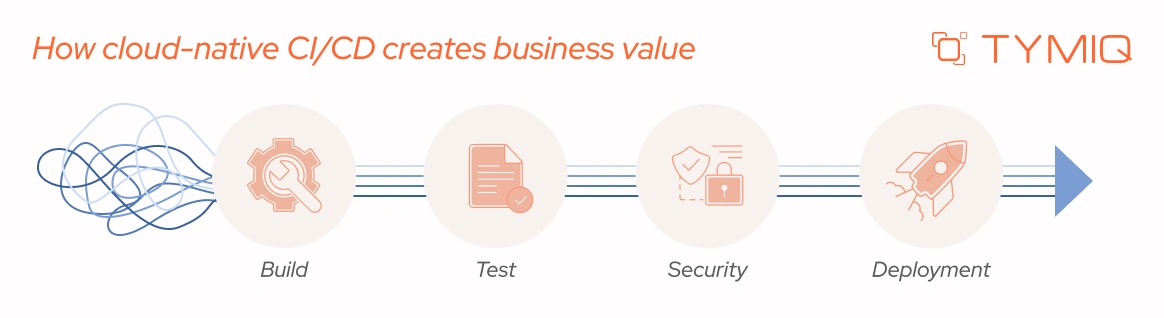
Accelerating time-to-market without sacrificing control
Faster delivery is often cited as the primary benefit of CI/CD, but speed alone is not the real objective for most organizations. What business leaders need is reliable speed – the ability to deliver changes predictably, without introducing instability.
Cloud-native CI/CD enables this by breaking work into smaller, verifiable units that move through automated pipelines. Instead of accumulating changes and releasing them in large, risky batches, teams deploy incremental updates that are easier to test, review, and roll back if necessary. Automated builds, parallel testing, and environment provisioning remove many of the delays associated with traditional release processes.
In practical terms, CI/CD accelerates delivery by:
- Eliminating manual build and deployment steps
- Reducing waiting time for shared environments
- Providing rapid feedback through automated testing
- Enabling frequent, low-risk releases
For the business, this means shorter lead times from idea to production, faster response to customer and regulatory demands, and a delivery cadence that supports continuous improvement rather than periodic disruption.
Reducing risk and improving operational stability
Delivery speed without stability creates fragility, and this is where CI/CD’s strategic value becomes most evident. Manual deployments and ad-hoc processes are inherently error-prone, particularly in complex systems where dependencies are not fully understood.
CI/CD mitigates these risks by enforcing consistency. Every change follows the same pipeline, is validated against the same criteria, and is deployed using the same mechanisms. Deployment strategies such as blue-green, canary, and rolling updates limit the blast radius of failures and make recovery faster and more predictable.
Let’s review a few common delivery risks – and how CI/CD addresses them:
For organizations running mission-critical systems, these improvements translate directly into higher availability, lower incident rates, and reduced operational stress on engineering teams.
Security and compliance embedded in delivery
In many organizations, security and compliance checks are still performed late in the delivery cycle, often as manual reviews before release. This approach increases friction and creates pressure to bypass controls when deadlines loom.
Cloud-native CI/CD supports a different model by embedding security and compliance checks directly into pipelines. Code analysis, dependency scanning, infrastructure validation, and policy enforcement can all run automatically as part of the delivery process. Every change is logged, versioned, and associated with a clear audit trail.
Typical DevSecOps capabilities within CI/CD pipelines include:
- Static and dynamic security testing
- Dependency and vulnerability scanning
- Secrets management and access control
- Policy-as-code enforcement
- Deployment approvals tied to identity and role
Rather than slowing delivery, this approach makes security repeatable and scalable – a necessity as systems become more distributed across cloud and hybrid environments.
CI/CD as a foundation for legacy system modernization
Legacy systems often present the greatest challenge to modernization. They may be business-critical, tightly coupled, and poorly documented, with release processes that rely heavily on manual intervention. As a result, teams are often reluctant to change them, even when modernization is clearly needed.
CI/CD enables a more measured approach. By introducing automation and standardization around existing systems, organizations can improve delivery reliability without rewriting applications wholesale. Builds, tests, and deployments can be automated incrementally, reducing risk while increasing visibility into system behavior.
CI/CD supports legacy modernization by:
- Wrapping automation around existing applications
- Reducing reliance on undocumented manual steps
- Improving observability and traceability
- Enabling hybrid architectures that combine legacy and cloud-native components
This incremental approach allows organizations to modernize delivery first, creating the conditions for bigger architectural changes over time. TYMIQ applies this model in practice, helping clients integrate legacy platforms into modern CI/CD pipelines while maintaining uptime and business continuity.
CI/CD approaches across major cloud providers
While CI/CD principles are consistent, implementation details vary across cloud platforms. Understanding these differences helps organizations align tooling choices with strategy and existing investments.
CI/CD on AWS
AWS provides a flexible CI/CD ecosystem built around services such as CodePipeline, CodeBuild, and CodeDeploy, with deep integration into IAM, CloudWatch, and infrastructure services. This approach offers fine-grained control and scalability, making it suitable for complex enterprise architectures.
AWS services are often paired with Infrastructure-as-Code tools to ensure consistency across environments, but it requires disciplined governance to manage complexity effectively.
CI/CD on Microsoft Azure
Azure’s CI/CD capabilities, delivered through Azure DevOps and GitHub Actions, are closely aligned with enterprise development workflows. Strong identity integration, hybrid cloud support, and governance features make Azure particularly attractive for organizations with existing Microsoft ecosystems.
Azure integration services support standardized delivery across teams while allowing flexibility for different application types and environments.
CI/CD on Google Cloud Platform
Google Cloud emphasizes cloud-native delivery patterns, particularly for containerized and Kubernetes-based workloads. Services like Cloud Build and Cloud Deploy support declarative, automated pipelines with strong observability.
Google Cloud in web development suits organizations adopting microservices, data-intensive platforms, or large-scale container orchestration.
CI/CD platform comparison
Vendor-independent CI/CD tools are often used to standardize delivery across cloud environments, but they are not always the optimal starting point. Choosing between platform-native and agnostic approaches requires an understanding of delivery risk, operating model, and modernization goals. The scorecard below is designed to support that evaluation.
CI/CD readiness scorecard (expert snapshot by TYMIQ)
Drawing on our experience integrating CI/CD into mission-critical and legacy systems, we distilled the key signals that reveal CI/CD readiness and the delivery risks to address before scaling.
Rate each area from 0 (not in place) to 3 (fully established).
1. Delivery and release control
- 0 → Manual or ad-hoc deployments
- 1 → Partial automation, manual approvals
- 2 → Automated pipelines with defined rollback
- 3 → Fully automated, low-risk releases
2. Architecture and legacy integration
- 0 → Legacy systems deployed manually
- 1 → Basic automation around legacy components
- 2 → Legacy systems included in CI/CD pipelines
- 3 → Legacy and cloud-native systems share pipelines
3. Cloud and environment consistency
- 0 → Mostly on-premise or manually configured
- 1 → Hybrid with limited standardization
- 2 → Infrastructure-as-Code for most environments
- 3 → Fully reproducible, cloud-first environments
4. Security and governance
- 0 → Manual security reviews
- 1 → Partial automation
- 2 → Security checks embedded in pipelines
- 3 → Policy-as-code with full auditability
5. Team and operating model
- 0 → Strong dev/ops/security silos
- 1 → Shared responsibility, informal processes
- 2 → Dedicated DevOps or platform team
- 3 → Product teams own delivery end-to-end
Count the total score (0-15):

Platform alignment guidance (high-level):
- AWS → Best fit for complex architectures requiring deep infrastructure control
- Azure → Strong choice for regulated, hybrid, or Microsoft-centric environments
- Google Cloud → Well-suited for Kubernetes-first and data-intensive platforms
- Hybrid / agnostic → Often optimal during phased modernization
In our experience, organizations scoring below 10 typically face delivery bottlenecks rooted not in tooling, but in legacy integration gaps and inconsistent governance. Addressing these areas early allows CI/CD to accelerate delivery without increasing operational risk.
Getting started: practical steps toward CI/CD transformation
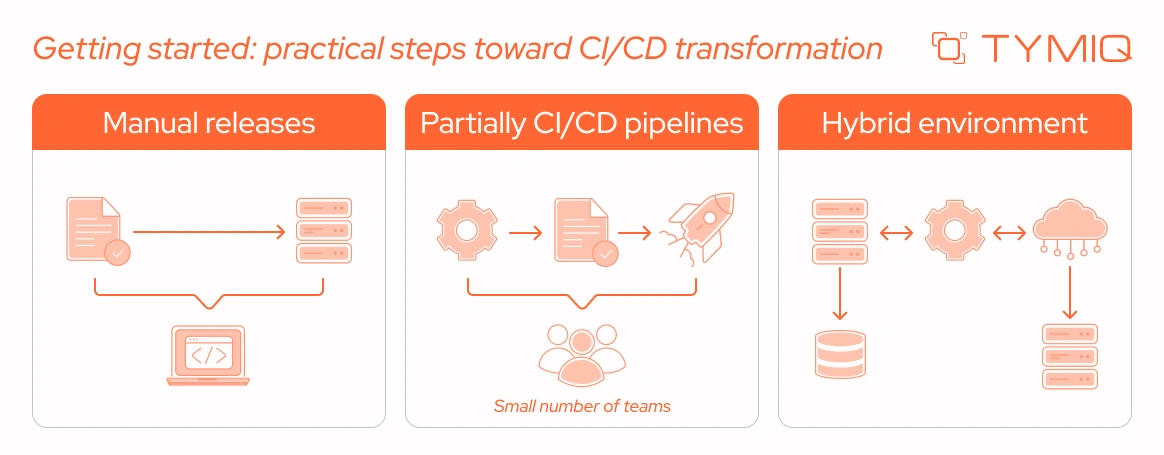
Organizations rarely begin CI/CD transformation from the same place. Some still depend on mostly manual releases, others have automation in place for a handful of teams, and many run hybrid setups where legacy systems and cloud-native services follow very different delivery paths.
All in all, meaningful progress starts with a clear view of how delivery actually works today. The steps below describe a practical, business-aligned way to establish that baseline and move toward cloud-native CI/CD with control and intent.
1. Assessing the current state
Effective CI/CD adoption starts with understanding existing delivery performance. This includes identifying manual steps, bottlenecks, and failure points, as well as measuring key indicators such as deployment frequency, lead time, change failure rate, and mean time to recovery.
These metrics provide an objective baseline for prioritization and help frame CI/CD investment in business terms.
2. Designing a scalable roadmap
CI/CD transformations are most successful when they proceed incrementally. Organizations typically start with one application or service, automate testing and builds, and expand pipelines gradually. Governance, security, and compliance requirements should be addressed early to avoid costly rework later.
A phased approach reduces risk while building confidence across teams.
3. Building the right team and сulture
CI/CD is as much an organizational change as a technical one. Success depends on collaboration between development, operations, and security teams, supported by shared standards and automation. External expertise can accelerate adoption by helping teams avoid common pitfalls and align delivery practices with long-term modernization goals.
CI/CD as a strategic capability
Cloud-native CI/CD has become a foundational capability for organizations pursuing digital transformation. It enables faster delivery, reduces operational risk, and provides a practical path for modernizing legacy systems without disrupting critical business operations.
By treating CI/CD as a strategic investment rather than a tooling exercise, organizations can align software delivery with business objectives and create a delivery model that supports growth and resilience. With deep experience in DevOps, cloud platforms, and legacy modernization, TYMIQ helps organizations design and implement CI/CD practices that deliver measurable value – today and over the long term.



.svg)


