


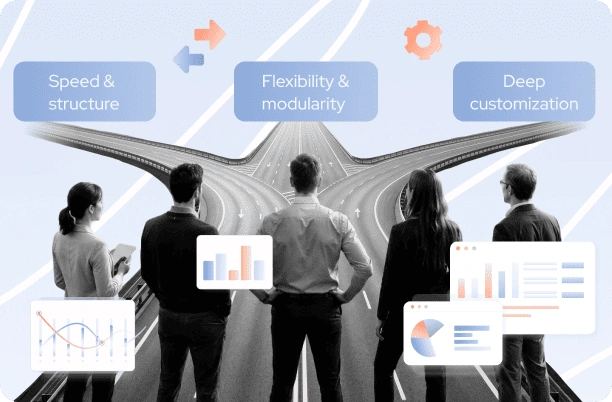
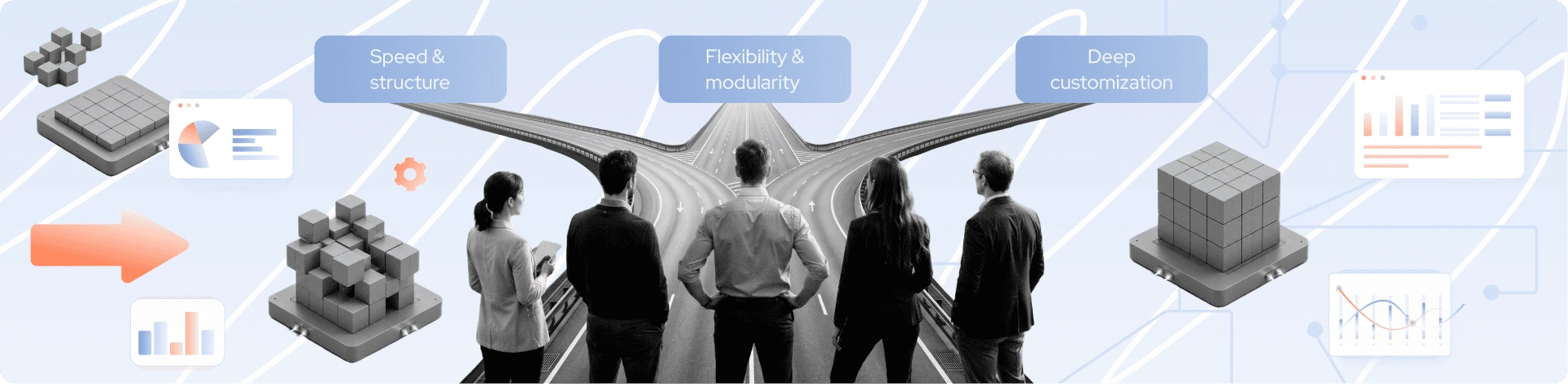
In the early stages of platform discussions, the focus typically falls on predictable issues: catalog management, the ordering process, integrations, and implementation timelines. On paper, the roadmap looks feasible, and everyone arrives with their own agenda. The sales team is counting on a faster launch. Product teams want flexibility. The finance team wants predictable costs. The engineering team wants fewer constraints.
Then the business grows.
A distributor requests negotiated pricing. Finance introduces approval requirements for larger purchases. Regional teams need country-specific workflows. Operations depend more heavily on ERP synchronization. New integrations begin affecting release timelines.
What looked manageable during platform selection slowly turns into architectural pressure.
As commerce operations grow more complex, platform flexibility tends to move higher on the priority list. Enterprise teams continue reporting friction tied to integrations, slower delivery, and systems becoming harder to adapt. This partly explains the growing interest in modular, API-first commerce architectures designed to adapt more easily as business requirements expand.
At this point, platform selection becomes less about choosing the “best” solution and more about choosing the type of complexity the organization is prepared to manage.
SAP Commerce Cloud, Broadleaf Commerce, and custom Java e-commerce each fit different growth stages. They also introduce different tradeoffs once systems grow.
This guide compares the three approaches through growth, complexity, and engineering tradeoffs to help decision-makers avoid solving next year’s problems with last quarter’s assumptions.
Why Java still powers enterprise e-commerce
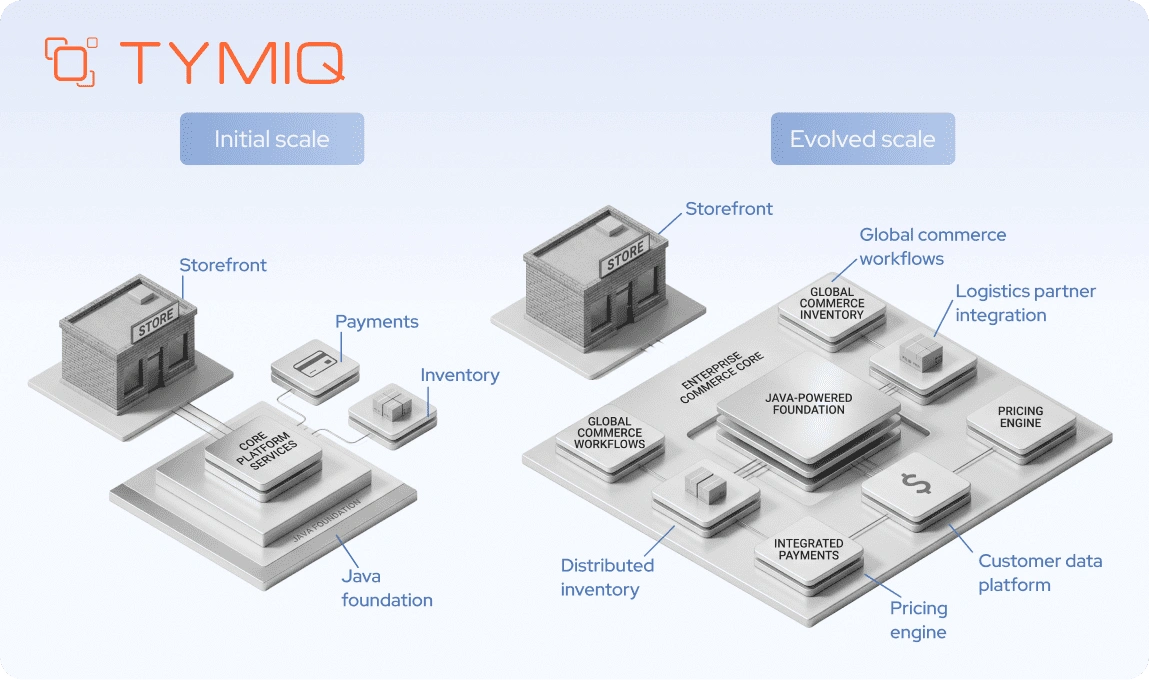
Commerce systems usually become more complex as businesses grow. Product catalogs get larger, integrations multiply, pricing logic evolves, and workflows become harder to standardize. Choices made early on often influence how easily the platform adapts later.
This partly explains why Java still holds a strong position in enterprise commerce. Large organizations often care less about launching quickly and more about stability, scalability, and handling integration-heavy environments over time. Java-based platforms continue supporting ecosystems like SAP Commerce Cloud, large commerce operations such as Amazon historically, and procurement-heavy businesses like Conrad Electronics.
A few factors explain why Java continues to be a common choice for enterprise commerce.
1. Enterprise integrations drive platform decisions
Commerce platforms rarely work in isolation.
Most businesses depend on ERP systems, CRMs, inventory management, logistics providers, payment services, pricing engines, and other systems constantly exchanging data behind the scenes. Java became common in enterprise commerce partly because it handles these integration-heavy environments well.
A manufacturer managing customer-specific pricing across multiple regions faces very different challenges than a retailer selling through one storefront. As systems, teams, and workflows grow, platform flexibility usually starts mattering much more.
2. Long-term maintainability matters more than launch speed
Many commerce systems remain operational far longer than teams initially expect. Product Owners and CTOs evaluating platform decisions often think beyond launch requirements.
Questions around upgrade paths, engineering availability, extensibility, operational stability, and ecosystem maturity tend to matter more after year two than during initial implementation.
A fast launch may feel successful early. Problems often surface later once platform limitations slow business changes.
3. Java supports different growth paths
Java commerce ecosystems support several architectural directions at once. Enterprise organizations managing procurement complexity often select SAP Commerce Cloud because mature B2B functionality already exists.
Organizations moving toward composable commerce may prefer Broadleaf Commerce because its modular architecture supports greater flexibility without requiring a full rebuild.
Businesses with specialized workflows sometimes outgrow packaged platforms and move toward custom Java e-commerce development once standard workflows become restrictive.
Platform selection becomes easier once teams define what business complexity they expect the architecture to support.
What product owners should evaluate before choosing a Java e-commerce platform
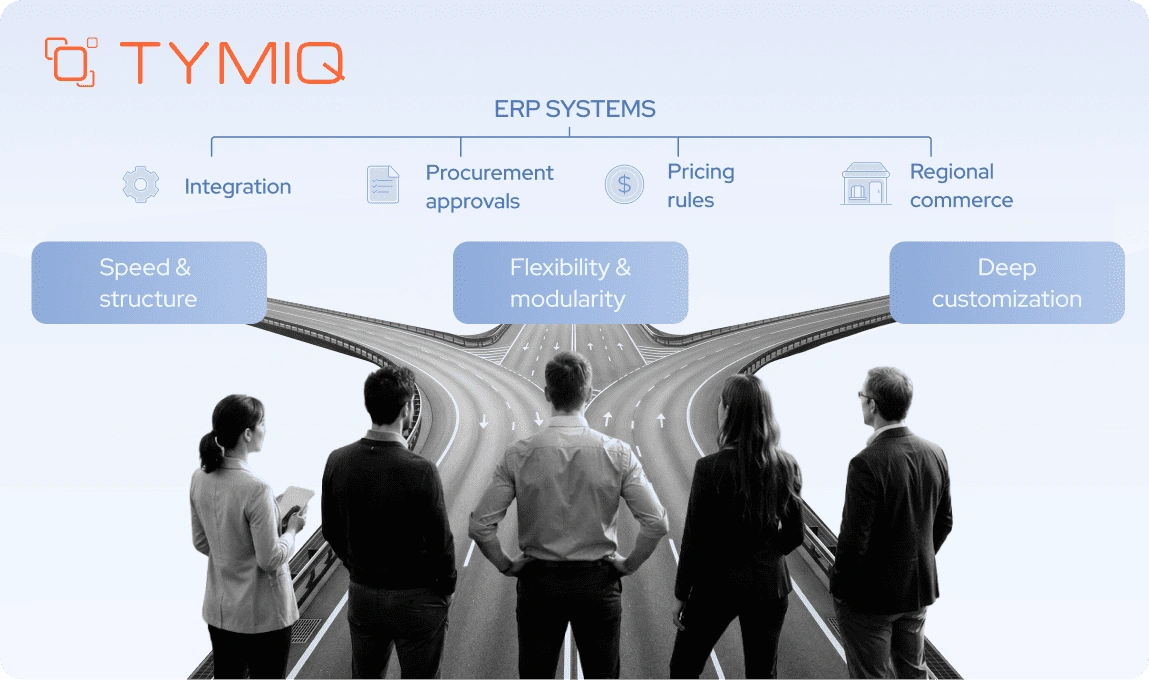
Nobody chooses a commerce platform expecting to revisit the decision two years later.
Still, platform discussions tend to return once integrations expand, and adapting the system starts taking more effort than expected.
By then, the platform choice influences delivery speed, operational flexibility, integration effort, and migration costs years after launch. IBM’s 2026 CEO Study found that 68% of executives expect greater flexibility from technology investments as business priorities change, though many still struggle to adapt existing systems quickly in more complex environments.
A few takeaways from the study feel especially relevant here:
- Technology flexibility increasingly affects how quickly businesses can respond to change
- Integration readiness plays a larger role in execution speed than many teams expect
- Legacy systems still slow adaptation across growing organizations
- Business priorities evolve faster than many platforms were originally designed to support
This pressure tends to become more visible once commerce systems grow more integration-heavy and workflows no longer fit standard platform assumptions.
Commerce teams face more pressure as B2B operations grow more complex. Negotiated pricing, procurement workflows, approval chains, self-service buying, and ERP synchronization quickly make platform decisions harder than they first appear.
This usually leaves teams balancing two competing priorities.
Too many platforms too early can increase cost and operational overhead. Too little flexibility can create friction later once integrations multiply, catalogs expand, and workflows become more specialized.
A few evaluation areas usually make the decision much clearer.
Business complexity
Business model complexity often matters more than storefront features.
A fashion retailer focused on promotions, seasonal campaigns, and checkout optimization faces different platform requirements than a distributor supporting quote requests, procurement approval chains, negotiated pricing, and customer-specific product visibility.
“I remember one project where everyone felt confident during platform selection because the workflows looked straightforward. Six months later, the business introduced customer-specific pricing, regional approval rules, and distributor exceptions nobody had planned for. The platform wasn’t failing. The business had simply become more complex than the original assumptions.”

Pricing logic rarely stays simple for long. Regional contracts, supplier agreements, customer segmentation, partner relationships, and volume discounts tend to expand as businesses grow.
Approval flows often follow a similar path. A purchasing process beginning with one approval layer may later involve department validation, procurement review, budget ownership, or country-specific requirements.
Questions worth asking at this stage:
- How likely are pricing rules to evolve?
- Could approval logic become more layered over time?
- Will procurement workflows matter after expansion?
- Could marketplace or distributor logic appear later?
- Are regional business exceptions already emerging?
- Would customer-specific catalogs become necessary?
Growth expectations
Platform fit changes as businesses scale. For instance, a commerce system supporting 50,000 SKUs creates different demands than one supporting millions of products across currencies, regions, warehouses, and fulfillment models.
International expansion increases complexity quickly. Regional catalogs, tax requirements, shipping models, localized pricing, and country-specific regulations often multiply faster than expected.
Traffic behavior also matters.
Flash sales, seasonal peaks, procurement deadlines, or distributor ordering cycles may place pressure on search performance, checkout stability, and inventory synchronization.
Questions worth asking at this stage:
- Will the catalog size increase significantly?
- Are international markets part of the roadmap?
- Could demand spikes become frequent?
- Might business models expand later?
Integration requirements
Commerce architecture often becomes an integration program.
Many organizations underestimate this because storefront functionality feels more visible during platform selection.
Commerce environments regularly depend on ERP systems, CRM platforms, PIM solutions, tax engines, logistics providers, payment gateways, and inventory synchronization systems.
“One thing we keep seeing is that integrations become the real project. People assume the storefront is the hard part, but once ERP syncs, pricing logic, inventory, customer data, and fulfillment systems start talking to each other, that’s usually where timelines get messy.” – TYMIQ developer
Teams sometimes assume the storefront creates the hard part. In practice, synchronizing pricing, customer records, product availability, procurement logic, and fulfillment data across systems often consumes more engineering effort.
Questions worth asking at this stage:
- How many systems require synchronization?
- Does ERP integration drive business operations?
- Are legacy systems unavoidable?
- Could data ownership become fragmented?
Engineering maturity
Teams often underestimate how much ownership comes with flexibility.
A modular platform sounds attractive until somebody has to maintain integrations, debug distributed failures, coordinate releases across services, or untangle deployment issues months later. Teams with stronger engineering foundations usually absorb this complexity more comfortably because observability, CI/CD practices, and service ownership are already mature.
This difference shows up consistently in software delivery research. Google Cloud’s DORA studies continue finding strong links between engineering maturity and delivery performance, particularly around deployment reliability, change management, and recovery speed in more distributed systems.
In practice, this usually becomes visible once teams need to coordinate changes across integrations, troubleshoot failures between services, or release platform updates without slowing delivery. Thus, leaner teams often prefer platforms with more built-in structure because fewer operational decisions stay in-house.
Questions worth asking:
- How strong is internal engineering ownership?
- How much customization will likely happen?
- Can teams maintain composable complexity long term?
These evaluation areas often narrow architecture choices quickly.
For organizations already operating at enterprise complexity, SAP Commerce Cloud frequently enters the discussion first.
SAP Commerce Cloud (Hybris): when enterprise complexity already exists
_%20when%20enterprise%20complexity%20already%20exists%20(2).webp)
SAP Commerce Cloud remains one of the most established Java e-commerce platforms for enterprise organizations.
Large B2B operations frequently choose Hybris because many difficult commerce workflows already exist inside the platform. Procurement logic, negotiated pricing, account hierarchies, approval chains, customer-specific catalogs, and ERP-heavy environments often align well with enterprise functionality already available.
This becomes more relevant as commerce operations grow harder to standardize.
Enterprise B2B organizations increasingly manage more complex buying journeys involving self-service procurement, role-based purchasing, account-level permissions, contract pricing, and ERP-connected ordering flows. SAP continues positioning these capabilities as core requirements for larger commerce environments where transactions involve multiple stakeholders rather than individual buyers.
For many organizations, Hybris reduces the need to build difficult commerce logic from scratch.
Quote workflows, approval hierarchies, shared purchasing accounts, customer-specific pricing, and ERP synchronization already exist within the platform ecosystem. Building similar functionality internally often creates a larger engineering commitment than teams initially expect.
Where SAP Commerce Cloud performs well
Hybris often fits organizations where commerce already depends heavily on operational complexity.
Typical signals include:
- ERP systems driving pricing or inventory
- Customer-specific contracts and catalogs
- Multi-region business operations
- Procurement approval chains already in place
- Standardization valued over experimentation
Where SAP Commerce Cloud creates friction
Teams often underestimate where implementation effort goes.
Storefront functionality tends to receive most attention during planning. In enterprise Hybris environments, integration logic, catalog synchronization, customer-specific pricing, approval workflows, ERP alignment, and data migration often consume more delivery effort than expected.
For organizations seeking more architectural flexibility without fully committing to custom development, Broadleaf Commerce often becomes the next option to evaluate.
Broadleaf Commerce, flexibility without starting from scratch
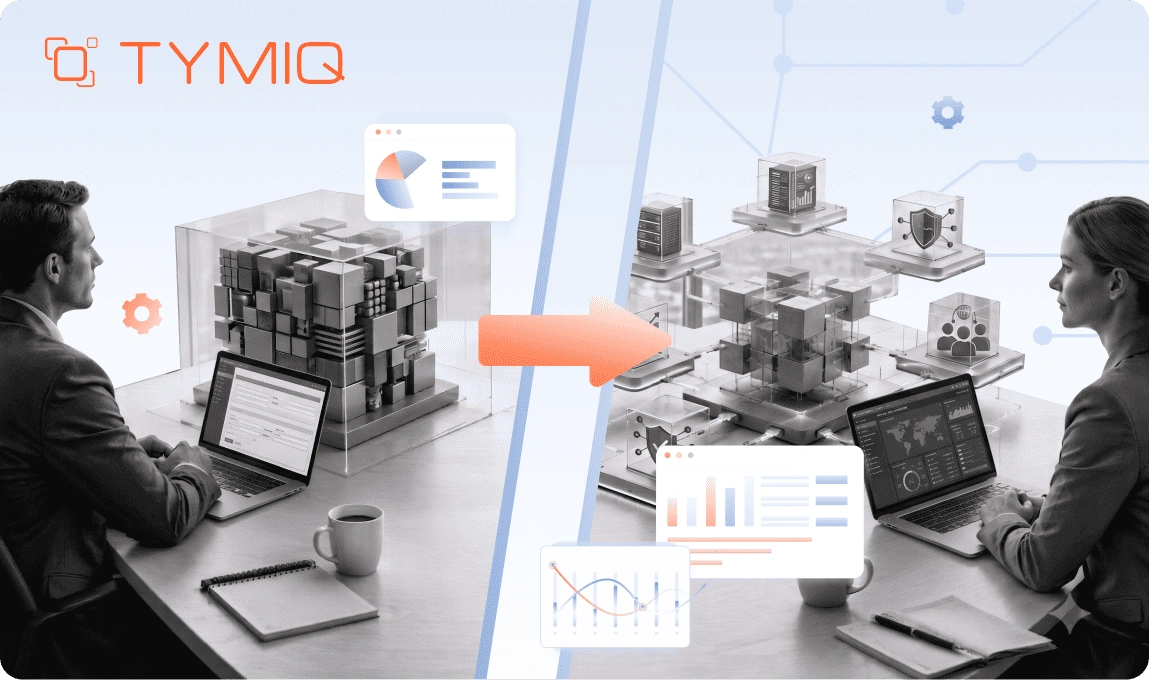
Some organizations outgrow the rigidity of enterprise commerce suites long before they are ready to build everything internally.
This usually happens when teams want more architectural control without taking on the full ownership burden of custom development. Broadleaf Commerce often enters the conversation here because it sits between packaged enterprise software and fully custom Java e-commerce.
Broadleaf positions itself around modular commerce services and API-first architecture. Teams can adopt capabilities incrementally and integrate commerce functionality more selectively than inside tightly coupled enterprise suites.
Where Broadleaf Commerce tends to fit best
Broadleaf often appeals to engineering-led organizations because teams retain more control over how commerce capabilities evolve.
Headless commerce strategies become easier to support when storefront experiences need more independence from backend logic. Businesses experimenting across channels, customer experiences, or frontend technologies often value this separation.
Customization also becomes easier to manage in many scenarios because teams work with modular components instead of adapting enterprise suite assumptions.
At the same time, flexibility increases engineering responsibility.
Where Broadleaf Commerce creates tradeoffs
Broadleaf rarely reduces complexity by itself.
Teams still need strong ownership around integrations, architecture, observability, deployment, and operational maintenance. Businesses expecting enterprise functionality immediately may underestimate the delivery effort involved in assembling commerce services more selectively.
One TYMIQ developer summarized the difference clearly:

Broadleaf often works well when teams want flexibility but still need commerce foundations in place. The hard part is staying disciplined about architecture once customization starts growing.
As a result, Broadleaf often fits organizations balancing two competing priorities: avoiding enterprise platform rigidity without fully committing to custom development.
For some businesses, even modular commerce frameworks eventually stop fitting operational
Custom Java e-commerce, when commerce becomes part of the business model
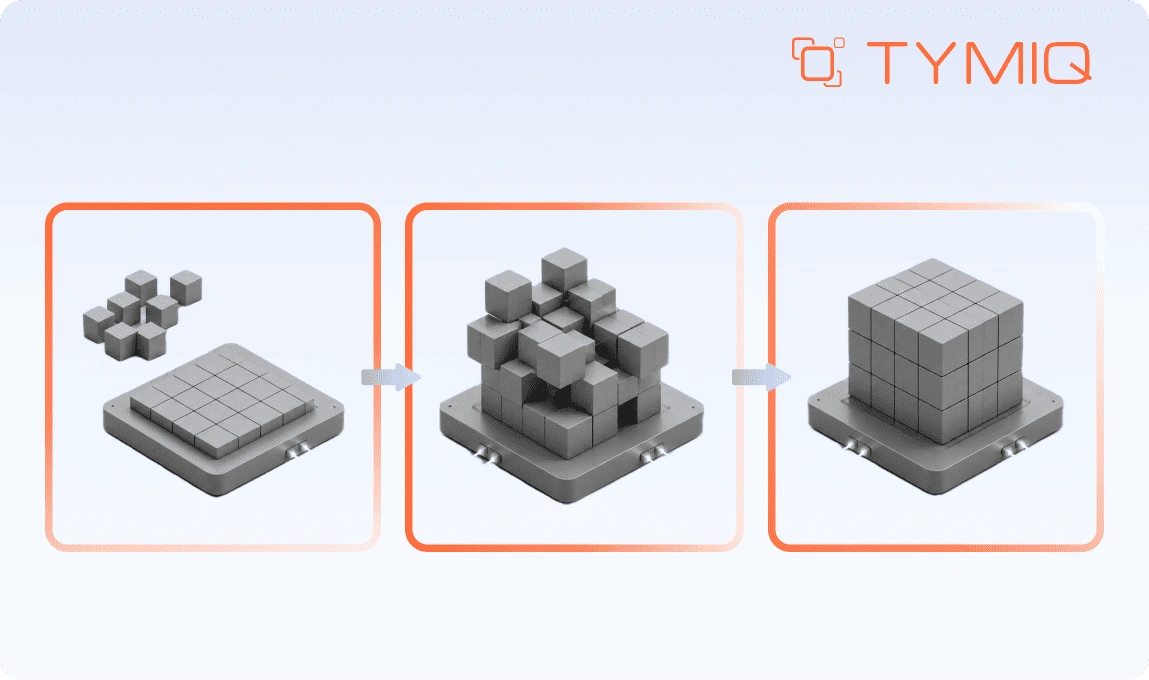
At a certain point, commerce stops feeling like standard e-commerce.
Pricing becomes more complex. Procurement workflows grow more specialized. Approval chains, regional rules, and ERP dependencies start shaping daily operations. This is often when teams begin questioning whether packaged platforms still fit the business.
Custom Java e-commerce tends to make more sense once business logic itself becomes part of the competitive advantage.needs.
Accenture’s Technology Vision points to a growing focus on flexible technology foundations as businesses struggle with rigid systems and growing technical debt.
It’s worth mentioning that technical debt rarely appears overnight. It usually accumulates through platform workarounds, integration complexity, and rushed architectural decisions. If this sounds familiar, take a look at our guide.
McKinsey’s work on digital reinvention also points toward increasing pressure on organizations to adapt digital systems more quickly as business models evolve, particularly across operationally complex environments.
This partly explains why some organizations move toward architecture built around their operating model rather than continuously adapting business logic to platform constraints.
Where custom Java e-commerce becomes a strong fit
Custom Java e-commerce often becomes attractive once standard commerce logic stops matching operational requirements.
Procurement systems, distributor networks, industrial sourcing platforms, regulated industries, and marketplace models frequently require workflows difficult to standardize inside packaged platforms.
This becomes especially relevant once commerce systems stop functioning as storefronts and begin acting as operational infrastructure. Supporting this level of complexity often requires more than platform expertise alone.
TYMIQ has contributed to enterprise Java environments where scalability, procurement logic, integrations, and operational reliability directly shape architecture decisions.
Where custom Java creates tradeoffs
Custom architecture increases freedom and responsibility at the same time.
Platform upgrades, observability, security, resilience, integrations, and infrastructure decisions remain internal responsibilities. Teams without strong engineering ownership often underestimate the operational discipline required once systems scale.
This does not automatically make custom development the stronger option. The stronger fit depends on how specialized the business has become.
Hybris vs. Broadleaf vs. custom Java e-commerce: a side-by-side comparison
Commerce leaders increasingly evaluate platforms through ownership tradeoffs, integration effort, and long-term flexibility rather than storefront functionality alone as commerce systems become harder to evolve over time. Let’s review all the details side by side, based on the most meaningful criteria.
The comparison rarely comes down to finding the “best” platform. Architecture fit usually depends on what type of complexity the organization expects to manage over time.
For product owners, the platform decision usually becomes clearer once teams evaluate four areas in sequence.
1. Business complexity
How specialized are workflows likely to become over time?
2. Integration requirements
How dependent will commerce become on ERP, PIM, CRM, logistics, pricing, and procurement systems?
3. Engineering maturity
How much architectural ownership can internal teams realistically support?
4. Growth expectations
Could regional expansion, procurement complexity, or new business models increase operational demands later?
The answers often narrow the architecture choice faster than feature comparisons.
To make the decision more practical, we put together a quick scorecard based on the factors most often shaping platform fit in real commerce environments.
Decision scorecard
Use this storecard to evaluate which platform aligns best with your business and technical priorities.
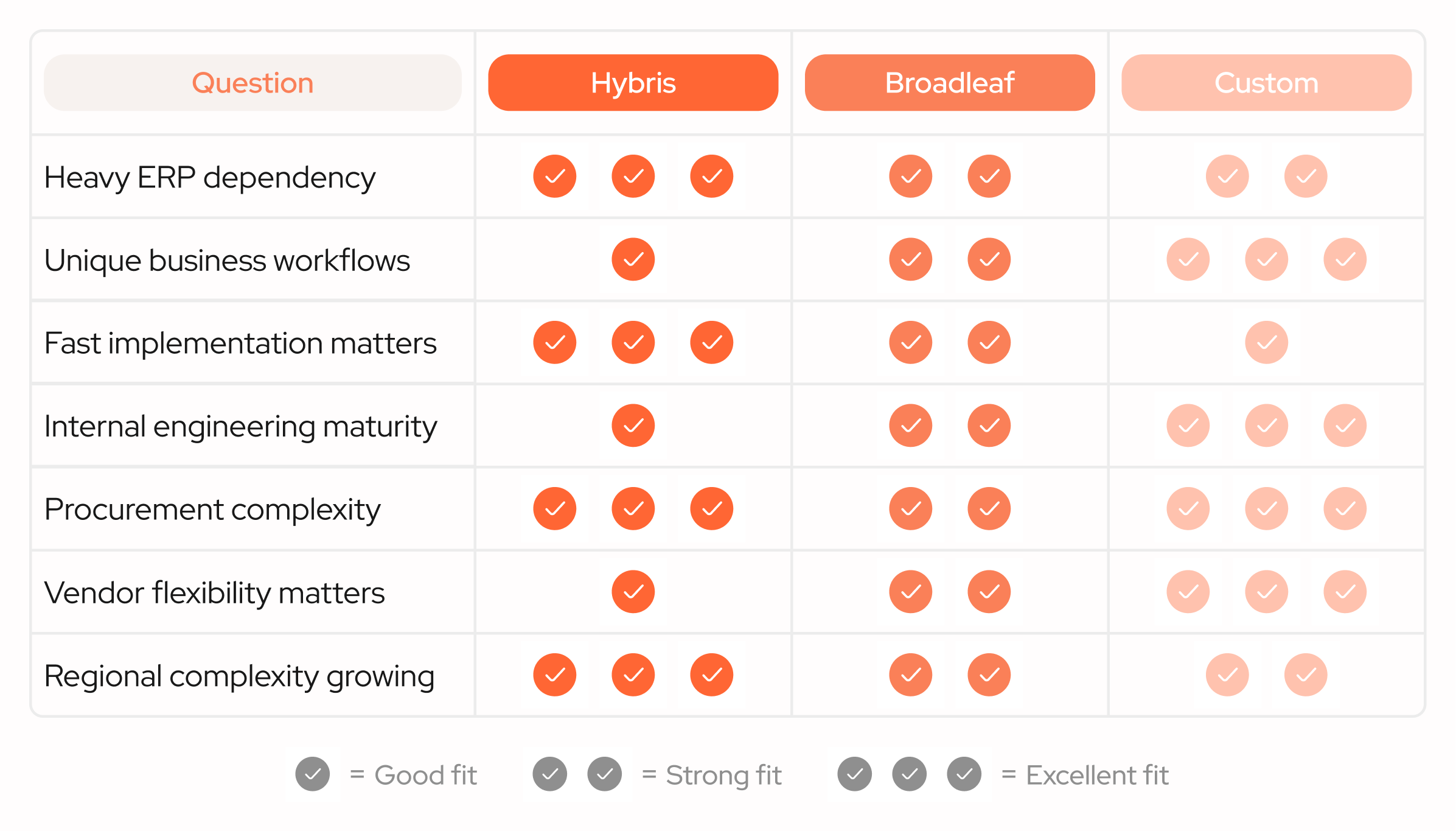
A simple interpretation often helps:
- Mostly Hybris → enterprise complexity already exists
- Mostly Broadleaf → flexibility matters without full ownership burden
- Mostly Custom → business logic increasingly drives architecture needs
Choosing for the business you expect to become
Java continues powering enterprise commerce because the ecosystem supports different architectural models as business requirements evolve.
SAP Commerce Cloud often fits mature enterprise environments where procurement complexity, ERP integration, and large-scale B2B workflows already exist.
Broadleaf Commerce tends to work well for organizations prioritizing flexibility without fully owning commerce architecture.
Custom Java e-commerce becomes more attractive once commerce workflows themselves start shaping how the business operates.
The harder part is rarely choosing what works today.
The stronger decision usually comes from evaluating what the business may realistically need two or three years from now.
Working through a platform migration or evaluating long-term architecture tradeoffs? Talk to TYMIQ about the practical differences between Hybris, Broadleaf, and custom Java development.


.svg)


