Legacy modernization consulting for healthcare software companies that need to move their platforms forward without losing the business logic, clinical workflows, and compliance posture that took years to build. We reduce technical debt and migration risk while keeping proven functionality intact.
Traditionally, analyzing a large software product could take months.
Using modern AI-assisted engineering workflows, we can reduce deep discovery and system understanding to approximately one week in many scenarios.
Over the years, clinical rules, billing calculations, and edge-case handling accumulate in the codebase, often with thin documentation and few original authors left. Before we change anything, we extract and document what the system actually does, so that the modernized version behaves the same way where it needs to.
HIPAA, GDPR, and local requirements apply to the system you have today and to every intermediate state on the way to the new one. We treat compliance as a constraint of the migration plan itself, including how data is handled in test and staging environments.
Legacy platforms are usually connected to EHR and EMR systems, laboratory and imaging equipment, and partner services through standards such as HL7, FHIR, and DICOM, or through custom interfaces nobody has touched in a decade. We map these integrations early, because they are often where migrations quietly go wrong.
Hospitals, clinics, and labs cannot pause for a release window of several weeks. We favor incremental approaches that keep the existing system running while new components take over piece by piece.
Patient and clinical records are not data you can afford to approximate. We plan migration with validation and reconciliation steps, so that you can verify what moved and what did not.
There is no single right answer for every platform, and we would rather help you pick the approach that fits than sell one by default. In practice, three options come up most often.
A full rewrite gives you a clean start, but it also means rebuilding years of embedded business logic and running two systems for a long time. It can make sense for small or already well-understood systems, and it is rarely the lowest-risk path for a mature healthcare product.
A rehost or lift-and-shift cloud migration moves the application to new infrastructure with minimal code changes. It delivers quick infrastructure benefits, but it does not address technical debt, and a monolith that is hard to change on-premises remains hard to change in the cloud.
Incremental refactoring and reengineering restructures the system in stages: isolating modules, extracting services where it pays off, upgrading frameworks, and moving to the cloud when the architecture is ready for it. It takes more upfront analysis, but it keeps the product live, spreads risk across smaller steps, and preserves the logic that already works. For most of the healthcare platforms we see, this is where the discussion ends up, and our discovery phase is designed to confirm it or tell you otherwise.
We review your codebase, architecture, dependencies, and documentation, then give you a prioritized view of risks, options, and a realistic roadmap.
We rework existing applications to improve maintainability, performance, and security while retaining the functionality your customers rely on.
We break down tightly coupled monoliths into well-defined modules or services, at the pace and depth your product and team can absorb.
We prepare applications for the cloud and migrate them to Azure, AWS, or GCP, with attention to data residency, access control, and regulatory requirements.
We address outdated frameworks, unsupported libraries, and fragile code paths in a planned way, so that the cost of every future change goes down.
We move and transform data between systems and rebuild or stabilize integrations with EHR, EMR, laboratory, imaging, and partner platforms.
We move and transform data between systems and rebuild or stabilize integrations with EHR, EMR, laboratory, imaging, and partner platforms.
We keep the legacy system stable during the transition and support the new one after release, so that there is no gap in ownership.
We keep the legacy system stable during the transition and support the new one after release, so that there is no gap in ownership.
There is no single right answer for every platform, and we would rather help you pick the approach that fits than sell one by default. In practice, three options come up most often.

Docker

Kubernetes

Keycloak

OAuth 2.0 / OIDC
Tell us about your platform, and our specialists will take it from there.
.png)

Software companies and product teams in healthcare, including:









Many of our healthcare projects are under NDA, so we show a selection of those we can share.
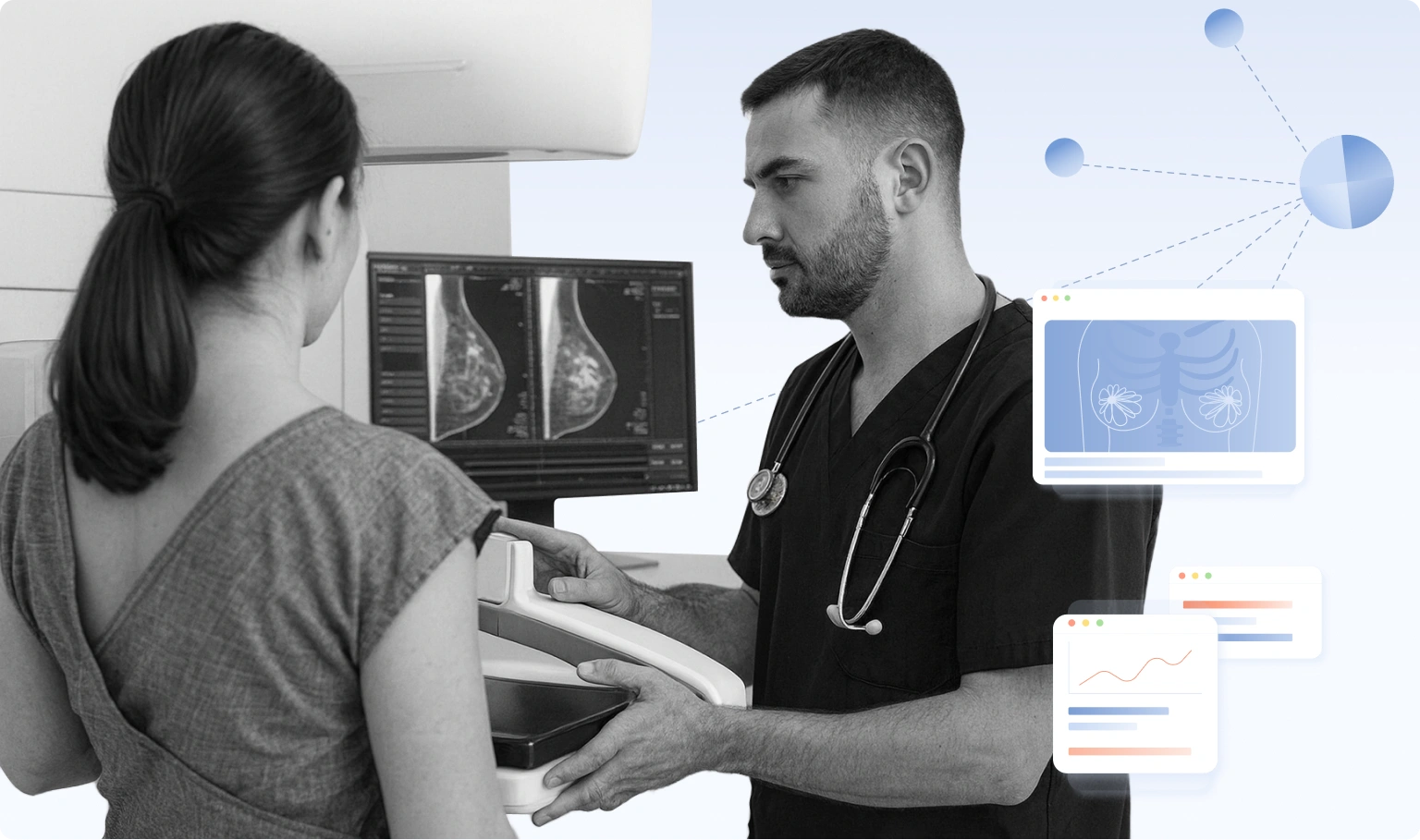
We implemented a web application to manage mammography scan results, streamlining the workflow for medical staff. The solution improved data organization, facilitated access to patient records, and enhanced overall efficiency in medical imaging management.
We developed a desktop application to manage hospital documents, including patient visit records and health reports. The solution optimized doctors' workflow, improved data organization, and facilitated efficient reporting. Future maintenance ensures the system remains reliable and up-to-date.


Modernization often needs people who can work inside your product team for months rather than weeks. TYMIQ provides dedicated developers through flexible engagement models, integrating with your team and processes. Projects typically start within 2–4 weeks.
Hire dedicated developersLegacy modernization is one of TYMIQ's core directions, and we have worked on long-lived systems across healthcare, insurance, aviation, and other regulated industries.
We document and verify what your system does before we change it, so that modernization does not turn into a hidden rewrite.
We work with HIPAA, GDPR, and similar requirements as design constraints, throughout the migration and not only at the end.
Projects begin within 2–4 weeks, with discovery as the natural first step.
We scale the team to the stage you are in, from a small assessment group to a full delivery team.
We start with discovery so that estimates are based on what we found in your code and architecture, and we keep you informed as the scope becomes clearer.

.svg)


Heweliusza 18, 60-281 Poznan, Poland
Szpitalna 8/6, 00-031 Warszawa, Poland
Feringastraße 6, 85774 Unterföhring, Germany
Heweliusza 18, 60-281 Poznan, Poland
Szpitalna 8/6, 00-031 Warszawa, Poland
Feringastraße 6, 85774 Unterföhring, Germany


.png)