


Imagine this scenario. It’s Monday. Your senior Delphi developer – the one who designed the architecture years ago – submits a resignation. There is no structured handover plan. The build server works, but nobody knows exactly how it was configured. Several third-party components are licensed under that developer’s account. The deployment checklist exists in a private notebook.
The product must ship an update in three weeks.
Can your team continue without disruption?
Research suggests many teams would struggle. A study of 133 popular GitHub repositories found that about 65% had a truck factor of two or fewer – meaning losing one or two key contributors could significantly disrupt development. Another study surveying 269 engineers confirmed that knowledge concentration is common and that version-control data often underestimates how dependent projects are on specific individuals.
For long-running Delphi systems, this risk is often even higher. Legacy code, accumulated design decisions, and undocumented business rules make the bus factor not just a team metric but a business risk.
This article examines what bus factor really means in practice, why legacy Delphi projects are particularly exposed, and how TYMIQ supports organizations in both preventive and recovery scenarios.
What is the bus (truck) factor?
The bus factor (sometimes called the truck factor) measures how many team members would need to become unavailable before a project stalls.
If your project has:
- Bus factor = 1 → one person holds critical knowledge
- Bus factor = 2 → two people are essential
- Bus factor ≥ 3 → knowledge is more distributed
The lower the number, the higher the risk. A bus factor of 1 is the worst possible number – it means that a single team member is crucial to the success of a project, the control of a system, or the operation of business-critical software.
Especially in industries where software directly impacts value creation processes – from order entry and production control to quality assurance – a bus factor of 1 can be existentially threatening. And yet, it is tacitly accepted in most companies. Not because no one sees the risk, but because inaction feels more comfortable than action. As long as nothing happens.
What may sound overly pessimistic is, in practice, far from rare. X X, Team Lead Software Engineering at TYMIQ, has observed this repeatedly. In his role, X regularly visits clients on-site, reviewing responsibilities, system architectures, and structural project risks.
He explains:
“Most companies know that certain individuals – especially those responsible for business-critical Delphi systems – represent a risk concentration. When key architectural knowledge about a legacy Delphi system sits with one person, the organization becomes vulnerable.”

The study Bus Factor in Practice examined how engineers perceive bus factor risk. Researchers concluded that commit history alone does not capture real knowledge ownership. Architects who guide design decisions, review code, and influence structure may not produce the most commits.
This matters in Delphi environments where senior developers often:
- Maintain architectural consistency
- Review critical changes
- Manage integration points
- Understand historical design trade-offs
Their influence extends beyond what version control systems record.
Why is bus factor the main risk of legacy Delphi systems
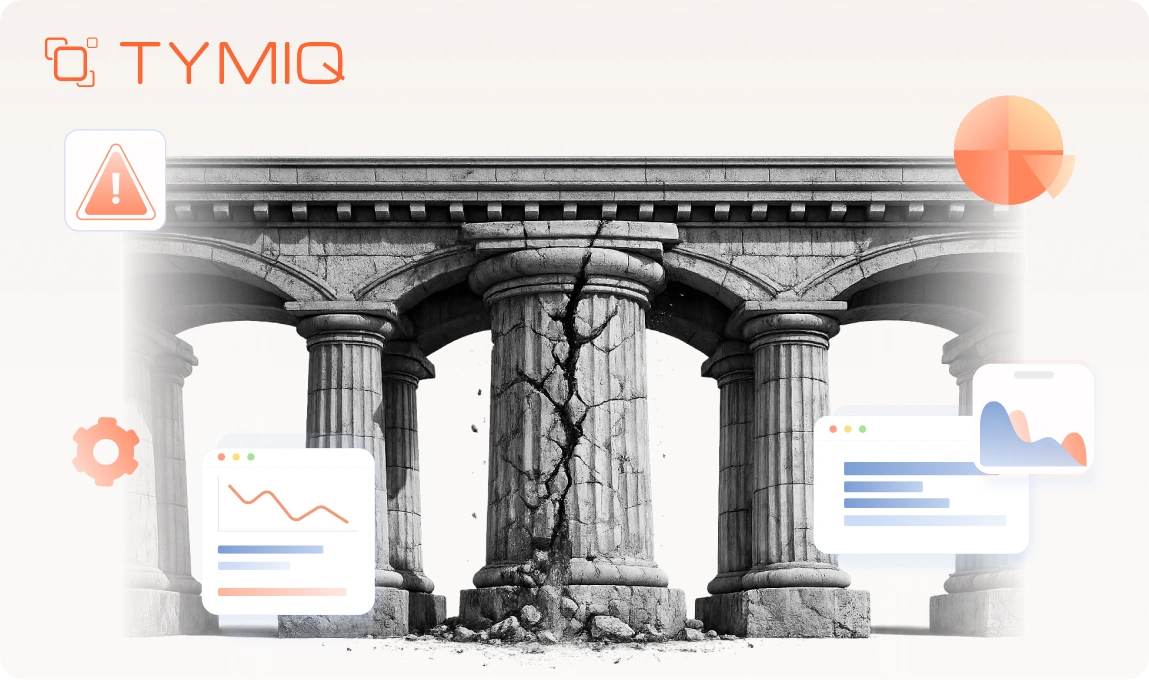
Many industrial and enterprise applications built with Delphi have been in active use for 10, 15, or even 20+ years. These systems often support core business processes such as production control, logistics, financial operations, laboratory management, or regulatory reporting.
In our dedicated article, we explained how long-running systems gradually become dependent on individual experts. Over time, critical knowledge accumulates around:
- Outdated architectural decisions
- Integration patterns shaped by past constraints
- Workarounds introduced under deadline pressure
- Business rules embedded deep in the code
This broader legacy pattern narrows directly into the bus factor problem in Delphi environments. Many Delphi applications have grown into structural vulnerabilities rooted in how legacy systems evolve.
This accumulation often takes a specific form:
- Custom VCL components created years ago for performance or UI flexibility
- Business logic embedded directly inside forms and event handlers
- Tight database integrations built on historical assumptions
- Incremental patches layered on top of earlier patches
- Architectural compromises made during urgent production incidents
Most of these decisions were rational at the time. They were responses to regulatory changes, urgent client requests, or operational pressure. Documentation was rarely prioritized when the system was stable, and customers were satisfied.
Thus, the longer the system lives, the more tacit knowledge builds up. When the bus factor is low, that tacit knowledge resides in one or two minds.
Replacing a senior Delphi developer is not equivalent to restoring lost knowledge. A new hire may be skilled in Object Pascal, but they do not immediately know:
- Why a specific module avoids a certain library
- Which integration points are fragile
- Which refactorings were attempted and rolled back
- What client-specific constraints shaped current architecture
That knowledge is rarely written down.
In discussing Delphi modernization, Oren Aviram, Legacy Delphi Modernization Expert & Embarcadero's Delphi MVP, highlighted core drivers and challenges that many teams face with legacy code. He explained that organizations often avoid modernization not because their systems don’t work, but because they lack clarity on how to begin the process:
“Many companies refrain from modernizing their legacy systems because they insist everything still works, are convinced there is no alternative, or simply don’t know how to approach it.”
This framing is useful when you're discussing why bus factor risk persists in Delphi systems – especially when teams are reluctant to document or restructure simply because “it works.”

Use this structured decision framework to evaluate talent dependency, architectural fit, and long-term exposure in under 10 minutes
What actually happens when a key Delphi developer leaves
Theoretical risk becomes operational reality quickly. Based on research ([1], [2]) and practical experience, common consequences include the following.
1. Build and environment instability
Symptoms frequently include:
- The application compiles only on one workstation
- Environment variables are undocumented
- Third-party packages lack centralized licensing records
- Deployment steps exist only in personal notes
These issues are often invisible until the key developer is unavailable.
2. Knowledge silos become visible
Business rules embedded in code without comments suddenly become obstacles.
Teams discover:
- Domain logic buried inside event handlers
- Conditional flows reflecting historical client agreements
- Hardcoded values whose origins are unclear
Research indicates that version control history does not capture tacit design reasoning.
3. Maintenance slows down
Bug resolution takes longer because engineers must first understand unfamiliar modules.
What previously required a quick fix becomes:
- Hours of exploratory debugging
- Cautious changes due to fear of regression
- Increased QA cycles
The original developer often fixed issues rapidly because they remembered design decisions.
4. Feature roadmaps shift
Planned features involving core modules may be postponed.
Managers face choices:
- Delay release
- Reallocate tasks
- Accept reduced scope
Short-term adjustments often cascade into long-term schedule changes.
5. Technical debt increases
Technical debt refers to the accumulated cost of taking shortcuts in development (like quick fixes, deferred refactors, and brittle integrations) that make future changes harder and riskier.
In a legacy Delphi system, temporary workarounds often remain in place not because they are the best solution, but because nobody feels confident removing or reworking them without the original author’s context. Planned refactors that once lived in the developer’s mind or personal notes disappear with that person, leaving code that is harder to understand, maintain, and evolve.
Over time, this compounded debt slows development velocity, raises the risk of regressions, and increases maintenance costs. For a deeper look at how technical debt builds up in legacy environments and how to address it systematically, see our dedicated article.
Practical checklist for reducing bus factor in Delphi
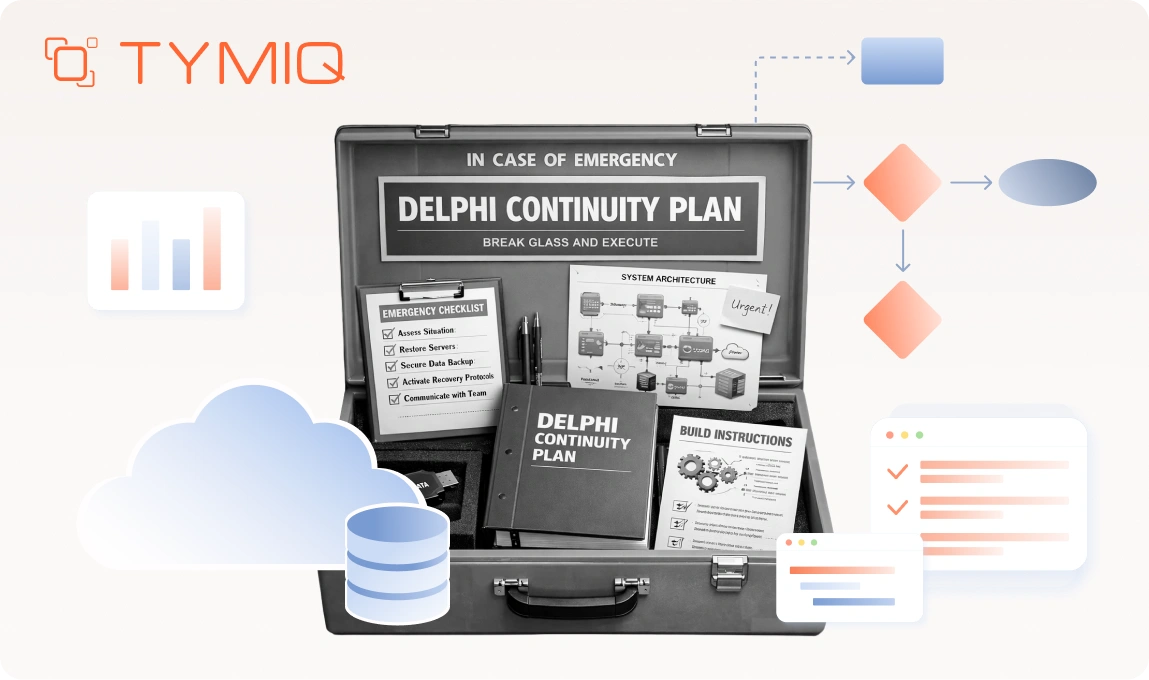
Reducing bus factor is not a one-time task. It requires structured effort, management support, and realistic prioritization. Many organizations underestimate the time required for knowledge transfer because documentation and cross-training compete with feature delivery.
The framework below outlines phased actions that balance operational continuity with long-term risk reduction.
Immediate actions (0-4 weeks)
The first phase focuses on visibility and operational resilience. These steps do not require an architectural overhaul, but they do require disciplined documentation and ownership clarity. A common challenge at this stage is resistance from teams who feel “everything already works” and question the need for additional effort.
- Document build instructions step-by-step, including environment variables and dependencies
- Centralize third-party component inventories and license information
- Assign secondary owners for every critical module
- Create smoke tests for core workflows to validate system stability
These actions reduce immediate dependency risk and create a baseline for further improvement.
When a key developer leaves, the technical gap is only part of the challenge. The remaining team often experiences:
- Increased uncertainty about system behavior and hidden dependencies
- Pressure to “own” unfamiliar modules without full context
- Fear of breaking fragile areas of the codebase
- Informal overwork as team members attempt to compensate
As a TYMIQ HR partner put it:
“When a long-term developer leaves, the team doesn’t just lose knowledge – they lose a reference point. People hesitate more, double-check decisions, and often feel exposed.”
For this reason, immediate visibility measures (such as clear documentation, ownership mapping, and reproducible builds) may reduce ambiguity and restore confidence across the team.
Medium-term actions (1-3 months)
The second phase addresses knowledge concentration more directly. This stage requires time allocation for structured knowledge transfer, which can feel costly in the short term. However, without deliberate sharing, expertise remains siloed.
- Conduct structured knowledge transfer sessions focused on architecture and integration logic
- Record architectural walkthroughs to preserve design rationale
- Introduce shared code reviews for core modules to distribute familiarity
- Document integration points and external dependencies systematically
A frequent challenge during this phase is uncovering undocumented assumptions that have shaped the system over years. Expect discovery work, not just documentation.
Long-term actions (3-12 months)
The third phase targets structural resilience. These initiatives require planning and often compete with roadmap priorities. Organizations may hesitate because improvements are not immediately visible to customers, yet they significantly reduce long-term exposure.
- Modularize tightly coupled components to reduce concentrated ownership
- Expand automated test coverage to support safe refactoring
- Formalize architecture documentation standards and update cycles
- Review bus factor annually using multimodal assessment methods
At this stage, the main constraint is sustained commitment. Without consistent follow-through, improvements may stall halfway.
Measuring progress
Reducing bus factor should be observable, not assumed. Progress can be tracked through operational indicators such as:
- Onboarding time for new developers working on core modules
- Average bug resolution time in historically concentrated areas
- Distribution of module ownership across the team
If onboarding becomes faster, review participation broadens, and bug resolution stabilizes despite personnel changes, bus factor risk is declining.
TYMIQ perspective: preventive and recovery support
In our experience, Delphi-related risk rarely appears suddenly. It builds gradually – until a triggering event forces action: a resignation, an audit finding, or a stalled roadmap initiative.
What follows isn’t based on abstract modeling. It reflects situations we’ve encountered across different Delphi environments over the years. On the surface, everything often appears manageable – the system runs, updates are delivered, and the team feels confident. It’s usually when responsibilities shift, or external pressure increases, that structural dependencies become visible.
In those moments, certain reactions tend to come up. They are understandable from an operational perspective, but a closer look often reveals how knowledge has gradually concentrated in ways that daily routines don’t immediately expose.
Across projects, two structured intervention paths tend to produce the most predictable outcomes:
Each has a different starting point, but both follow a disciplined process designed to restore clarity and reduce dependency risk.
1. Preventive knowledge transfer
When a key developer is still present, the objective is controlled knowledge distribution — not disruption.
This phase typically begins with a focused assessment and results in tangible artifacts that remain inside the organization.
It often includes:
- Bus factor and ownership mapping across critical modules
- Architectural documentation of high-risk components
- Dependency and integration analysis
- Structured knowledge transfer workshops with recording and documentation outputs
- Codebase risk scoring (complexity, coupling, maintainability indicators)
The goal is to make knowledge portable. How knowledge is documented (whether in a project repository or shared documentation system) is critical to system continuity and can, in some cases, prevent serious operational disruption.
2. Post-departure recovery
When a key developer has already left, the situation requires stabilization before optimization.
The first objective is operational continuity. The second is structural clarity. This phase commonly includes:
- Reverse engineering undocumented modules
- Reconstruction of build and deployment environments
- Identification of fragile integration points
- Architectural reconstruction workshops
- Establishment of maintainable documentation baselines
- Optional ongoing maintenance support
Why structured intervention matters
Legacy Delphi systems can almost always be stabilized. The difference between prolonged disruption and controlled recovery lies in structure:
When these elements are present, recovery becomes predictable. Without them, even minor personnel changes can cause disproportionate disruption.
In a nutshell
Delphi decisions are rarely technical in isolation. They affect risk exposure, investment timing, and architectural flexibility for years ahead. And bus factor is a measurable indicator of organizational resilience.
Legacy Delphi systems, with accumulated tacit knowledge and specialized architecture, are especially exposed.
When a key developer leaves, the impact extends beyond code. It affects maintenance speed, feature delivery, technical debt, and business confidence. The risk can be reduced through documentation, cross-training, modularization, and structured knowledge transfer.
If your Delphi system depends heavily on one or two individuals, now is the time to evaluate your bus factor.
TYMIQ provides both preventive audits and post-departure recovery support for legacy Delphi environments.



.svg)


