


Modern enterprises run on software built over decades. Many of those systems still power billing, logistics, banking, manufacturing, and government services. The problem appears when technology stops evolving with business needs. Development slows. Security updates grow harder. Integrations fail to keep pace with modern platforms.
A recent modernization survey reported that 62% of organizations still rely on legacy systems for core operations. These systems often run on aging architectures that limit scalability and slow innovation.
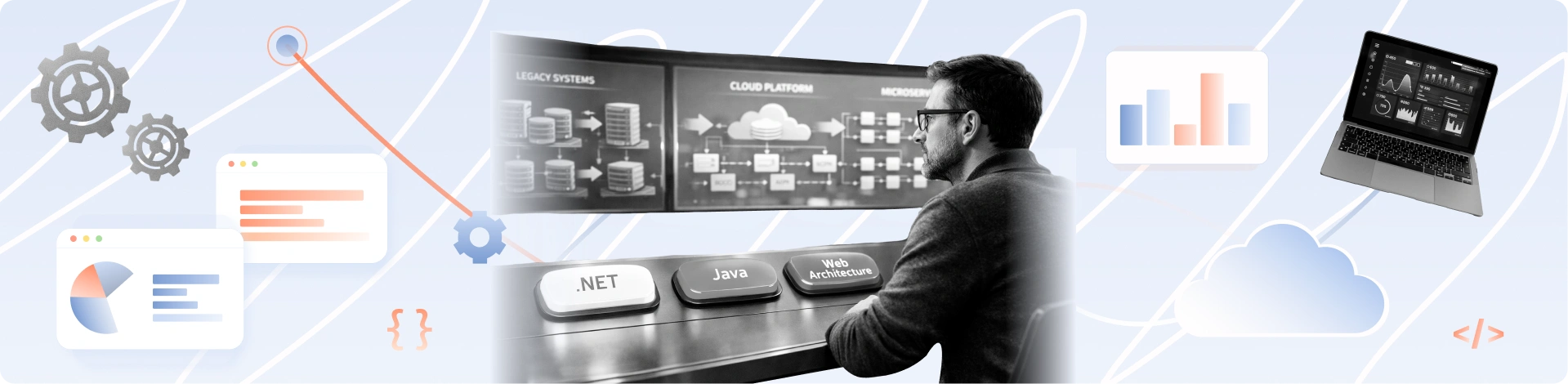
Technology leaders face a decision. Should the organization migrate the system to .NET? Should the team rebuild on Java? Should the application become a modern web platform?
Architects answer these questions by evaluating business requirements, development capacity, and long-term architecture goals. This article explains how experienced architects approach the decision. You will see when rewriting software makes sense, when incremental modernization works better, and when platforms such as .NET, Java, or modern web architectures deliver the best outcomes.
Why legacy system migration has become a strategic priority
Legacy systems still run many critical operations across large organizations. Financial services platforms, logistics software, manufacturing control systems, and government services depend on applications designed years ago.
However, business expectations changed. Digital services must evolve faster, integrate with external platforms, and support real-time interactions across devices. Older architectures were not designed for this level of agility. When companies try to extend these systems, development teams quickly discover technical limitations.
You can see the tension during daily engineering work. Adding new features takes longer, cloud integrations need custom connectors, and security updates become manual patching sessions. These challenges accumulate over time and start slowing the entire delivery pipeline.
Typical warning signs include:
- Development teams spend most of their time maintaining existing code instead of building new capabilities.
- Integrating with cloud services or modern APIs requires complex adapters.
- Security vulnerabilities appear in older libraries that no longer receive updates.
- Data access becomes difficult because the architecture was not designed for modern analytics workloads.
- Recruiting engineers with experience in older frameworks becomes harder each year.
When several of these issues appear together, the organization begins to feel the operational cost of legacy infrastructure. Teams move more slowly, operational risk increases, and innovation stalls.
Industry data supports this trend. A survey of more than 500 IT professionals found that 62% of organizations still rely on legacy systems for core business operations. Many of these systems require modernization because they limit scalability and increase maintenance overhead.
Maintenance costs also grow steadily as technology ages. Older frameworks lose vendor support, and security updates become difficult to manage. Some organizations report spending up to 80%of their IT budgets on maintaining legacy infrastructure instead of improving digital products.
Cloud migration often becomes the next step in this modernization journey. If you are evaluating this transition, we’ve already covered a practical overview of the process. The guide explains how organizations assess legacy environments, plan migration phases, and manage dependencies during the transition.
This perspective matters for engineering leaders. Migration decisions affect architecture, development workflows, and operational models across the entire organization.
Architects begin with a strategic question. Which migration approach reduces risk and supports long-term evolution?
The three core migration strategies architects use
Before you choose between .NET, Java, or a web stack, you first need to decide how the system will evolve. Platform selection follows architecture strategy. Most architects evaluate three migration approaches, each designed for different levels of system complexity and operational risk.
Each strategy addresses a different situation. Your decision usually depends on the system's current health, the scale of the application, and how much disruption the business can tolerate.
1. Rewriting the application from scratch
A full rewrite replaces the legacy platform with a completely new system. Engineers design a modern architecture, rebuild the business logic, and migrate historical data into the new environment.
This approach works best when the current system blocks further growth. Many desktop platforms built twenty years ago fall into this category. Their architecture cannot support cloud scalability, API integrations, or mobile access.
The advantages become visible once the new system launches. The application runs on modern frameworks, security standards improve, and cloud infrastructure supports horizontal scaling.
The risks remain significant. Enterprise rewrites often require several years of development. Teams must validate thousands of workflows and edge cases that have accumulated over decades. Hidden dependencies often appear late in the project and create delays.
Because of this risk profile, large organizations rarely rewrite critical systems unless the platform becomes impossible to maintain.
2. Incremental refactoring
Incremental refactoring modernizes the system gradually. Engineers improve specific components of the architecture without replacing the entire application.
This strategy keeps the legacy platform running during modernization. Development teams introduce APIs, improve code quality, and migrate selected modules to modern frameworks.
Many organizations begin modernization in areas where improvements deliver immediate value:
- data access layers that limit performance
- authentication systems that require stronger security controls
- integration modules that connect to external APIs
- reporting systems that block modern analytics tools
Over time, these changes reshape the architecture into a more modular system. Teams gradually move from tightly coupled monoliths toward service-oriented platforms.
3. Strangler pattern migration
The strangler pattern replaces the legacy platform in stages. New services appear around the existing system and gradually absorb its responsibilities.
Architects usually place a gateway or proxy in front of the application. Incoming requests pass through this layer, which routes traffic either to the legacy system or to newly built services.
Each new feature gets implemented in the modern architecture. Over time, the legacy components shrink until the original system disappears.
This strategy reduces operational risk. Business operations continue during the transition, and development teams release improvements continuously.
Large enterprises frequently apply this approach when modernizing monolithic Java or .NET systems. Gradual replacement allows teams to evolve the platform without exposing the organization to large-scale failures.
Key factors architects evaluate before choosing a platform

Technology choices rarely begin with programming language preferences. Experienced architects start with operational constraints, team capabilities, and long-term architecture goals. The platform should support how your organization builds, deploys, and operates software.
Architects usually evaluate a small set of practical factors before committing to a stack:
- Team expertise. A development group experienced in C# and Azure will move faster with .NET. Teams working daily with Spring Boot and JVM tooling often prefer Java.
- Infrastructure alignment. Organizations running most workloads on Microsoft services often select .NET because identity management, monitoring, and deployment pipelines integrate smoothly with Azure.
- Performance requirements. Systems processing large transaction volumes need efficient runtime environments and frameworks designed for high throughput.
- Ecosystem maturity. Mature ecosystems reduce development friction because they provide reliable libraries for authentication, database access, messaging, and monitoring.
Here’s how each factor influences the .NET vs Java decision in practice
Architects review these factors together before committing to a platform. The strongest choice usually aligns with your team’s skills, infrastructure, and the scale of the system you plan to operate.
When .NET is the best migration choice
The .NET ecosystem has evolved into a cross-platform runtime with strong performance characteristics. Modern versions run on Linux, Windows, and macOS. Development tools support cloud native architecture and container deployments.
Performance benchmarks highlight the maturity of the platform. Independent TechEmpower benchmarks show ASP.NET Core processing millions of requests per second in JSON workloads, ranking among the fastest web frameworks tested.
Another analysis shows ASP.NET Core delivering more than 160% higher throughput than Node.js in several benchmark scenarios, including JSON serialization and cached queries.
Recent platform releases also improve runtime efficiency. Benchmark comparisons show applications running about 7% faster when moved from .NET 9 to .NET 10 without code changes.
These performance improvements make .NET attractive for high-traffic APIs and enterprise platforms. In practice, architects recommend the platform when the organization’s technology stack already aligns with the Microsoft ecosystem. The table below summarizes situations where .NET is often a strong choice and where another platform may fit better.
When Java becomes a stronger option
Java remains a dominant platform for enterprise software development. Banks, telecom operators, and large enterprise vendors rely on Java ecosystems built over decades.
The strength of Java comes from ecosystem maturity and stability, and industry trend reports show modernization accelerating across its ecosystem. The InfoQ Java Trends Report 2025 notes that Java 17 has effectively become the new baseline for many major frameworks, with tools such as Spring, JUnit, and Gradle now requiring Java 17 or higher. This shift reflects how enterprise teams actively upgrade platforms and modernize large codebases.
Modern frameworks such as Quarkus and Micronaut also optimize Java applications for container environments. These frameworks reduce startup times and memory usage in cloud deployments.
Architects recommend Java when organizations operate large-scale distributed systems and already depend on the JVM ecosystem. The platform has a long track record in enterprise environments, especially in industries that require stability and predictable performance under heavy load.
When rewriting as a web application is the smartest move
Another migration option involves rebuilding the system as a modern web platform. Instead of maintaining a desktop or client-server application, architects redesign the system around browser interfaces and API-driven services.
This approach simplifies deployment and expands access across devices. Users work through a browser instead of installing local software. Updates are deployed centrally, and APIs support integrations with mobile apps and partner platforms.
Many organizations adopt this model when converting legacy client-server systems into SaaS platforms. Modern web architectures also support modular services and scalable cloud infrastructure.
The practical side of choosing .NET, Java, or the web

Technology decisions rarely happen in isolation. Architects align platform choices with business priorities, operational models, and the existing technology landscape.
Different types of organizations tend to favor different platforms:
- Enterprises deeply integrated with Microsoft infrastructure often adopt .NET because Azure services simplify deployment, identity management, and operational monitoring.
- Financial institutions frequently rely on Java for systems that process large volumes of transactions and require stable distributed architectures.
- Startups and SaaS companies often choose web-first platforms because they support rapid product iteration and cross-platform access.
- Large enterprises sometimes combine platforms. For example, Java services may handle transaction processing, while .NET supports internal enterprise tools.
In practice, architecture decisions often lead to hybrid environments. Frontend systems usually run on web frameworks, while backend services operate across multiple platforms depending on operational needs.
What TYMIQ architects recommend for successful migrations
Across modernization programs, architects at TYMIQ often see the same patterns emerge. Technology selection works best when it supports business strategy and aligns with the organization’s engineering capabilities.
Many architecture teams treat migration planning as a series of practical checks before committing to a platform or strategy. These checks help reduce risk and keep modernization efforts aligned with operational reality.
Several lessons appear repeatedly in enterprise migration projects:
1. Start with your team
Choose platforms that align with your engineers’ skills and existing operational tooling. When the team already understands the ecosystem, delivery speed improves, and onboarding time drops.
2. Reduce risk through gradual change
Favor migration strategies that allow incremental validation. Step-by-step modernization lets teams test architectural changes without disrupting production systems.
3. Approach full rewrites with caution
Legacy platforms often contain years of embedded business logic and accumulated technical debt. Many of these rules only become visible when engineers begin migrating real workflows into the new system.
4. Use automation to understand the system first
Modern code analysis tools help teams map dependencies and identify architectural bottlenecks across large codebases before refactoring begins.
Successful migrations rarely depend on a single technology decision. They depend on disciplined architecture strategy, incremental delivery, and clear alignment between technology choices and business priorities.
Top 3 migration mistakes organizations make
Modernization projects rarely fail because of technological limits. Most failures come from planning decisions made early in the migration process. Architects often see the same patterns repeated across different industries. Recognizing these mistakes early helps you avoid costly delays and unstable systems.
Choosing a platform your team cannot support
Many organizations select a new framework based on market trends instead of internal capabilities. When engineers lack experience with the chosen ecosystem, development slows, and operational mistakes increase. Training new teams during a migration project also introduces additional risk.
Underestimating legacy system complexity
Legacy systems often contain decades of accumulated business logic and technical debt. Many dependencies remain undocumented until engineers begin migrating real workflows. Integration points, data transformations, and edge cases often appear later in the migration process.
Attempting a large rewrite without phased delivery
Large-scale rewrites delay feedback from real users and production workloads. Problems surface late in the project when architectural changes become expensive. Migration programs without incremental checkpoints often experience schedule overruns and unstable releases.
Experienced architecture teams approach modernization differently. How to reduce operational risk and improve the system gradually without disrupting critical business processes?
Technology selection then follows organizational capabilities.
- Choose .NET when your organization already runs Microsoft infrastructure or needs high-performance APIs integrated with Azure.
- Choose Java when your system relies on large-scale distributed processing or already runs within the Java ecosystem.
- Choose a web-first architecture when your organization wants global accessibility, SaaS delivery models, and rapid feature deployment.
Technology matters less than strategy
Migration decisions influence the future of your organization’s digital platform. The best choice rarely depends on language popularity or framework marketing. Your organization may choose .NET, Java, or modern web platforms. Each platform can support enterprise-scale applications when implemented with strong architecture practices.
The critical step involves selecting the right migration strategy. Gradual modernization reduces risk and protects business operations. Clear architectural goals guide technology selection.
If your organization plans a migration, start with the strategic questions architects ask first:
- What business problem does modernization solve?
- Which migration approach reduces operational risk?
- Which platform aligns with your team’s expertise?
Answer these questions carefully. The technology decision will follow naturally.



.svg)


