




Cloud migration is often treated as a technical upgrade: move workloads, retire data centers, and expect faster delivery. In practice, it changes how systems are built, secured, funded, and supported.
That gap between expectation and execution explains why cloud migration challenges continue to surface even in organizations with experienced engineering teams. Across industries, those pain points tend to center on security ownership, cost visibility, legacy application behavior, and skills readiness.
Below, we outline the challenges of cloud migration teams are most likely to face in cloud migration in 2026 and find out how teams deal with them once systems are running in production.
Challenge 1: Security and compliance don’t automatically improve in the cloud
Cloud providers secure the underlying infrastructure, but customers remain responsible for identity, access, configuration, and data handling under the shared responsibility model.
Many cloud migration issues around security stem from a misunderstanding of this boundary. The 2025 State of Cloud Security Report from Orca Security shows that customer-side misconfigurations – especially overly permissive IAM roles and publicly exposed storage – remain the leading cause of cloud security incidents.
One US-based healthcare services provider discovered this during a post-migration audit. While the infrastructure passed baseline checks, auditors identified public object storage and service accounts with broad permissions. The organization paused further migrations and introduced baseline configurations enforced through infrastructure-as-code and continuous scanning.
Therefore, while cloud platforms protect the underlying infrastructure, customers remain responsible for how identities are managed, how resources are configured, and how data is accessed and stored. This division of responsibility is formally defined in the shared responsibility model used by all major cloud providers.
How this challenge typically shows up
Security issues in the cloud rarely appear as a single obvious failure. More often, they accumulate gradually as environments expand and teams optimize for speed rather than consistency.
- IAM permissions expand organically during migration: Temporary access granted to unblock teams often becomes permanent. Over time, roles accumulate privileges that exceed their original purpose, increasing the blast radius of any compromise.
- Cloud-native defaults are assumed to be secure without review: Default network settings, storage permissions, or service configurations are frequently accepted as “safe enough,” even though they are designed for flexibility rather than strict compliance.
- Security reviews happen after go-live, not before
Audits and formal reviews are postponed until workloads are already in production, at which point fixing issues becomes more disruptive and expensive.
This challenge is especially common in organizations where speed and scale are prioritized early in migration:
- Regulated industries (healthcare, finance): Compliance requirements make misconfigurations more costly, both financially and operationally.
- Fast-moving product teams: Teams focused on delivery may bypass security reviews to meet deadlines, assuming controls will be added later.
- Organizations with multiple cloud accounts or subscriptions: As environments multiply, consistency becomes harder to enforce without centralized standards and automation.
Challenge 2: Cloud costs grow faster than expected

Cloud pricing models are flexible by design, but that flexibility often makes costs harder to predict once workloads scale. Consumption-based billing, managed services, and autoscaling can quietly shift spending patterns, especially when teams migrate quickly without revisiting how applications consume resources.
Industry surveys consistently show that cost management remains the top cloud concern for organizations, with many reporting significant waste tied to unused or overprovisioned resources.
How this challenge typically shows up
Cost issues rarely appear as a single budget overrun. Instead, they surface gradually as environments evolve. Let’s review some of the most common red flags.
- Spending increases without corresponding traffic growth: Costs rise even when user activity remains flat, often due to inefficient configurations, idle resources, or background services left running.
- Engineering teams lack visibility into billing data: Invoices are reviewed centrally, but engineers don’t see cost impact tied to their design decisions, slowing corrective action.
- Optimization happens reactively, not continuously: Cost reviews occur only after budgets are exceeded, rather than being built into normal operational workflows.
Who is most affected:
- SaaS and digital-native companies with variable workloads
- Organizations with decentralized teams managing their own cloud resources
- Fast migrations where cost controls are deferred until “after go-live”
Challenge 3: Legacy applications don’t fit cloud operating models
Many legacy systems were designed for static infrastructure, predictable capacity, and tightly coupled components. When these applications are moved to elastic, distributed cloud environments without adjustment, their assumptions often break.
This isn’t just a theoretical concern. Both academic research and industry experience show the same pattern: legacy applications struggle in the cloud when architectural readiness isn’t addressed up front. Studies on legacy software migration point to dependency complexity, outdated platform assumptions, and poor readiness assessment as leading causes of migration delays and failures.
In many cases, teams end up refactoring under pressure after go-live – often at higher cost and risk than if those changes had been planned earlier.
How this challenge typically shows up
Legacy constraints surface quickly once systems are exposed to cloud dynamics.
- Applications fail to scale predictably
State-heavy components, tight coupling, or synchronous dependencies prevent effective autoscaling. - Operational complexity increases instead of decreasing
Teams spend more time managing workarounds than benefiting from cloud-native capabilities. - Modern tooling can’t be adopted easily
CI/CD, observability, or automation tools clash with legacy deployment patterns.
This challenge is especially common among:
- Enterprises with long-lived platforms that have accumulated technical debt over many years
- Monolithic or tightly coupled applications that were never designed for elasticity
- Teams with limited modernization resources or unclear refactoring strategies
Without deliberate refactoring or redesign, legacy applications in the cloud may exhibit poor performance under dynamic workloads and generate higher operational costs due to inefficient resource use.
Challenge 4: Downtime and business continuity remain a real risk
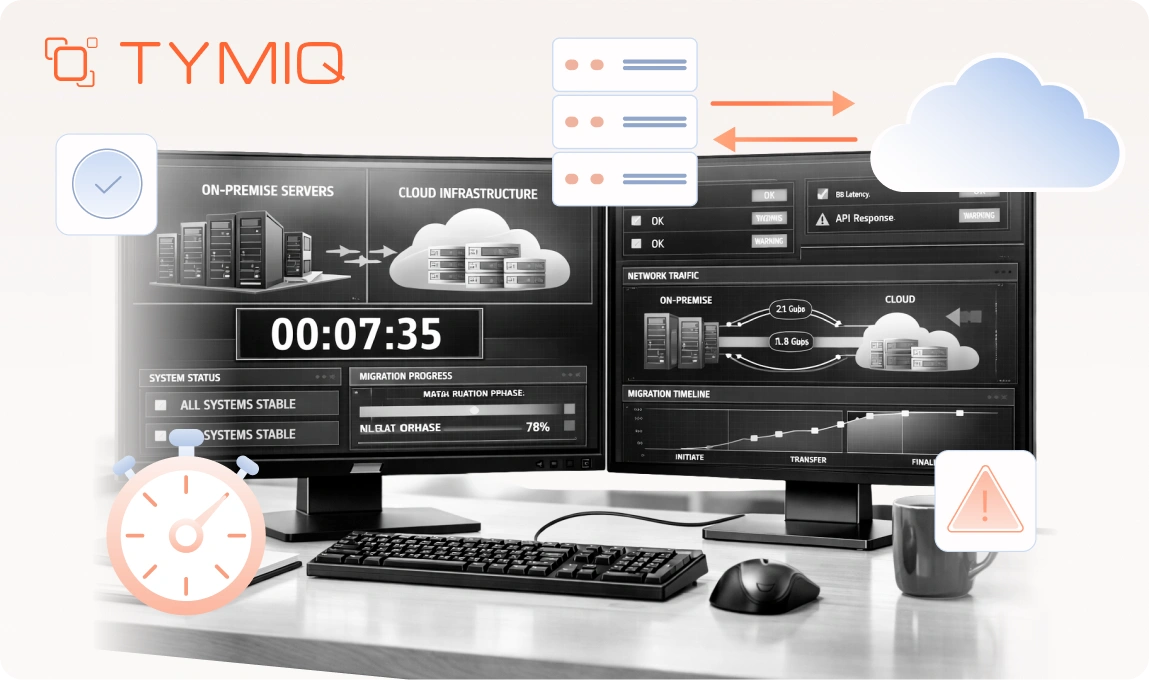
Cloud migration introduces multiple transition points – data synchronization, traffic cutover, and dependency realignment. When these steps are rushed or insufficiently tested, downtime becomes likely.
This risk increases in hybrid environments, where on-premises and cloud systems must operate in parallel during migration.
How this challenge typically shows up
Downtime risks are often underestimated during planning.
- Cutover windows are too aggressive: Teams compress rehearsal and validation to meet deadlines, leaving little margin for error.
- Rollback paths are unclear or untested: When issues arise, teams struggle to revert safely without additional disruption.
- Dependencies are discovered late: Hidden integrations surface only during live traffic, complicating recovery.
Who is most affected:
- Customer-facing platforms
- Regulated or high-availability systems
- Complex hybrid environments
Challenge 5: Skills gaps slow progress after migration
Such a common situation: a few weeks after go-live, the system is technically stable – but small issues keep piling up. Alerts fire more often than expected, and no one is quite sure which service or setting is responsible. The migration itself is “done,” yet day-to-day operations feel harder, not easier.
This is a common turning point. Cloud platforms change how systems are built and operated, but skills don’t automatically evolve at the same pace. Many teams discover after migration that routine operations require expertise they don’t yet have. Industry analysis shows that cloud skills shortages persist well beyond initial migration phases, especially in security, networking, and automation.
How this challenge typically shows up
- Operational incidents take longer to resolve: Teams lack confidence diagnosing cloud-specific failures.
- Security and cost controls are inconsistently applied: Best practices exist on paper but aren’t enforced day to day.
- Automation stalls after migration: Teams revert to manual processes due to unfamiliar tooling.
Who is most affected:
- Teams who are new to cloud-native operations
- Fast-growing engineering organizations
- Companies migrating multiple platforms simultaneously
This challenge is common – and it’s solvable. Teams that close cloud skills gaps don’t try to “train everyone on everything” at once. Instead, they focus on a few operational fundamentals first: shared ownership for on-call responsibilities, clear runbooks for recurring issues, and gradual automation of the most error-prone tasks.
Pairing hands-on learning with real production scenarios, rather than abstract training alone, helps teams build confidence faster. Over time, consistent exposure to cloud-specific incidents, cost reviews, and security workflows turns unfamiliar tooling into routine practice – and restores the operational simplicity teams expected from the cloud in the first place.
Challenge 5: Data migration is slower and riskier than planned
Most teams go into data migration thinking it’s mainly a transfer task: move the data, run a final check, and move on. In practice, it often becomes one of the biggest sources of delays and rework in cloud projects. Recent reports show that over 80 % of data migration efforts miss deadlines or exceed budgets, largely because early assumptions don’t hold up once real data is involved.
Some familiar issues like inconsistent or undocumented schemas, partial or interrupted loads, and unclear ownership of data quality aren’t edge cases. They show up repeatedly in digital transformation programs where legacy data formats, disconnected sources, and years of accumulated inconsistencies collide with cloud expectations.
By the time discrepancies surface – often after cutover – teams are already in remediation mode, fixing issues under pressure instead of validating data in a controlled way during migration.
How this challenge typically shows up
Data issues often emerge gradually.
- Validation is postponed until after cutover: Errors accumulate unnoticed until users report discrepancies.
- Bandwidth and transfer time are underestimated: Large datasets take longer than expected to move and verify.
- Rollback plans are incomplete: Teams lack clear recovery points once data diverges.
Who is most affected:
- Data-heavy platforms
- Analytics and reporting systems
- Legacy databases with inconsistent schemas
Challenge 6: Strategy choices: hybrid, multi-cloud, and vendor dependence
Cloud strategy decisions shape system design, operational effort, cost behavior, and how difficult it is to change direction later. Vendor-specific managed services can speed up delivery but often increase dependency on a single platform.
In many organizations, these choices emerge gradually rather than through deliberate planning. Early decisions – often made under delivery pressure – tend to persist. The impact becomes clear later, when outages, pricing changes, or regional limits expose how tightly systems are coupled. At that point, adjusting the strategy usually involves significant rework, and hybrid or multi-cloud patterns appear as corrective measures rather than planned architecture.
How this challenge typically shows up
Strategic tradeoffs become operational issues.
- Portability was not planned early: Exiting or adding providers becomes expensive later.
- Operational complexity increases unexpectedly: Supporting multiple platforms strains teams.
- Governance differs across providers: Policies become inconsistent.
Where this creates the biggest risk:
- Regulated organizations
- Global enterprises
- Teams with resilience or procurement constraints
Challenge 7: Performance and latency issues appear after go-live
Performance assumptions made in testing rarely hold under real traffic. Network paths, regional placement, and service dependencies behave differently in production.
Cloud performance guidance consistently notes this gap between test and live environments.
How this challenge typically shows up
Performance problems emerge only at scale.
- Response times increase under load
- Cross-region calls add unexpected latency
- Scaling increases cost without fixing bottlenecks
Contexts where this risk is highest:
- Latency-sensitive applications
- Globally distributed systems
- High-throughput platforms
How to apply cloud migration best practices in real projects
Cloud migration challenges tend to repeat because execution often moves faster than governance, cost controls, and operational readiness. Teams that manage this well treat migration as an operating change that unfolds over time, not a single delivery event.
At TYMIQ, this perspective comes from hands-on work across complex migration and modernization projects in different industries. Our team combines architectural, operational, and delivery experience gained from real production environments – where assumptions are tested under load, audits, and real users. Based on that experience, we’ve outlined a set of practical recommendations that help teams anticipate issues beforehand.
1. Before migration starts: establish guardrails early
Before production workloads move, several foundational measures should be in place. These align with widely adopted cloud governance guidance. Key recommendations include:
- Define ownership for security, cost, and operations to ensure every environment has accountable decision-makers.
- Establish baseline configurations for identity, networking, logging, and storage so new environments start from a consistent, reviewable state.
- Enable cost visibility early using budgets, alerts, and tagging to connect design choices with financial impact from day one.
Without these guardrails, teams often detect security gaps or cost issues only after environments and dependencies have multiplied.
2. When issues arise: respond with diagnosis, not reaction
Once workloads run under real traffic, issues around cost, performance, and configuration are inevitable. Mature responses focus on isolating causes rather than applying blanket fixes.
Effective practices include:
- Reviewing service-level usage when costs spike, rather than freezing spend or scaling blindly.
- Validating dependencies and region placement before adding capacity, as network paths often drive latency.
- Comparing live environments against known baselines to identify configuration drift early.
Teams that skip this diagnostic step often increase cost or complexity without resolving the underlying issue.
3. After go-live: stabilize before expanding further
Go-live should be treated as a checkpoint, not a finish line. Stabilization activities typically include:
- Reviewing security posture under actual usage, adjusting permissions based on real access patterns.
- Analyzing cost behavior across teams and services to confirm workloads align with business expectations.
- Monitoring performance trends, not just incidents, to catch slow degradation before it becomes disruptive.
The best practices for cloud migration emphasize predictability over speed.
Conclusion
Most cloud migration problems are caused not by technology gaps, but by underestimating operational change.
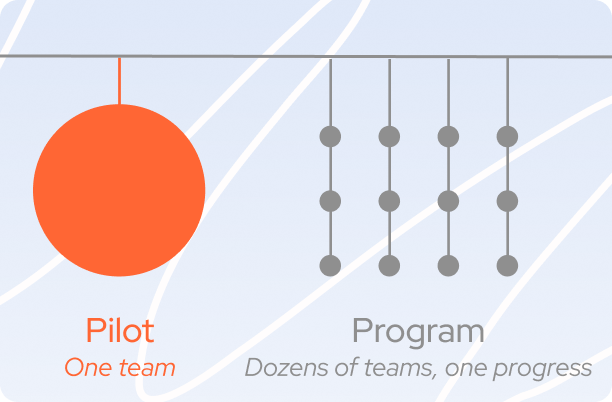
Successful teams treat migration as a managed program, revisiting assumptions once systems are live. The real question isn’t whether workloads can move – but whether teams are ready to operate them.


.svg)


