


.png)

Why do so many AI initiatives show early promise, then become harder to scale?
AI can feel surprisingly straightforward in the beginning. A pilot works, teams see productivity gains, and broader adoption starts sounding like the obvious next step.
The picture often changes once organizations try to scale. Data sits across disconnected systems, integrations take longer than expected, and older applications struggle to support new AI requirements.
That is where AI modernization becomes important. Last year’s McKinsey State of AI survey highlights how quickly users’ expectations are changing. Around 23% of organizations reported scaling agentic AI systems somewhere in the business. The finding matters because many organizations are still working through earlier adoption stages.
This guide explains what AI modernization means, why many companies struggle to scale AI, how to build an AI modernization strategy, and what a practical modernization roadmap looks like in 2026.
What is AI modernization?
AI modernization is the process of preparing systems, applications, data, and workflows so artificial intelligence can work effectively across the business.
Many organizations already operate in digital environments, using cloud software, analytics tools, automation, and internal systems every day. Still, digital maturity does not automatically mean AI readiness. Customer data may sit across departments, legacy systems can limit integrations, and manual work often slows adoption even after AI tools arrive.
This is where AI modernization matters. The goal is straightforward: remove the technical and operational blockers that stop AI from becoming part of day-to-day business operations.
In practice, AI modernization often touches several areas of the business at once. Depending on priorities, organizations may focus on:
- Updating legacy applications so systems connect more easily
- Improving data quality, accessibility, and governance
- Modernizing infrastructure through cloud or hybrid environments
- Redesigning workflows to reduce repetitive manual work
- Strengthening security, compliance, and oversight
- Preparing teams to adopt AI more effectively
Walmart offers a useful example. Over several years, the company invested heavily in cloud infrastructure, data platforms, and application modernization to improve how information moves across operations. Those changes helped support broader AI use in forecasting, supply chain operations, and inventory management.
The example highlights an important point. AI adoption becomes easier when systems, data, and workflows are prepared to support larger-scale deployment.
Why AI adoption slows in enterprises
Most enterprise AI initiatives start with a clear use case. A product team tests an internal copilot. Customer support automates repetitive requests. Marketing experiments with content generation.
Early results often look promising because pilots happen inside controlled environments with clean data, limited scope, and fewer dependencies.
Scaling tends to be harder.
Leadership wants AI used across departments. Teams request deeper integrations. More systems need to exchange information, and governance requirements become harder to ignore. What worked well in one business unit often becomes more complex at the enterprise level.
Research reflects this gap between experimentation and execution. McKinsey’s State of AI report found that although experimentation with generative AI has become widespread, only around 23% of organizations reported scaling agentic AI systems somewhere in the business. Many companies are still working out how to move from successful pilots to day-to-day operational use.
At the same time, access to AI inside organizations is growing quickly. Deloitte’s report found worker access to AI increased by 50% in 2025. More teams are getting exposure to AI tools, though governance, workforce readiness, and operational integration continue to slow broader adoption.
Security concerns add another layer of complexity as organizations handle larger volumes of sensitive information across connected systems. In May 2026, NYC Health + Hospitals disclosed a breach affecting around 1.8 million people, including stolen medical records, insurance details, and biometric data such as fingerprint scans. Cases like this explain why security and compliance reviews become more rigorous as AI initiatives expand.
PwC’s 2026 Digital Trends in Operations Survey found:
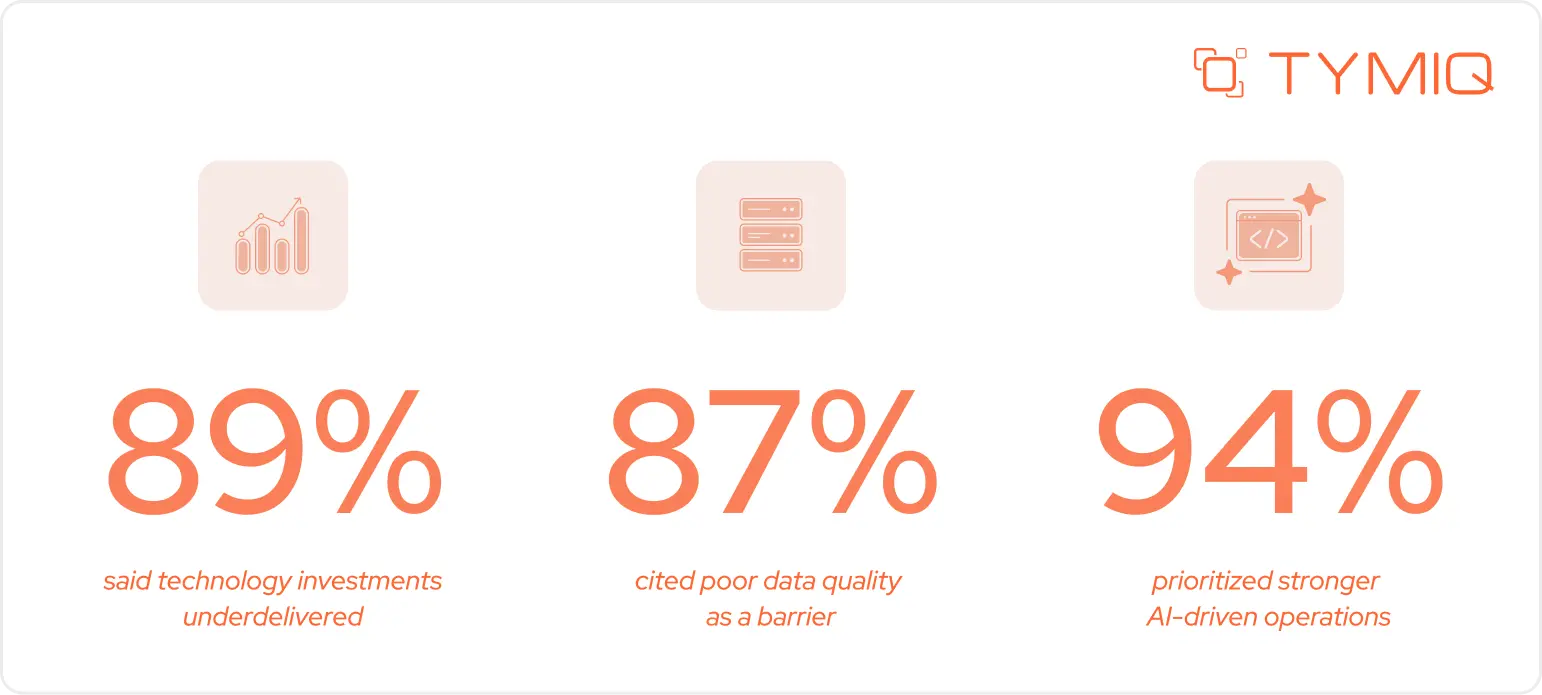
The numbers point to a common issue. Early pilots often succeed because teams work with controlled datasets and fewer dependencies. Enterprise deployment exposes problems tied to fragmented systems, inconsistent data, outdated infrastructure, and unclear governance.
These problems share a common root: enterprise systems were not originally designed for AI. Let’s review some of the most common barriers.
What slows AI adoption in enterprises?
Knowing where adoption slows helps explain why modernization has become a strategic priority. For many organizations, the focus then shifts toward readiness, and so do we.
Signs your business may need AI modernization
Have you ever looked at an AI initiative and thought, “Why did scaling suddenly become this hard?”
Morgan Stanley faced a version of this during its rollout of generative AI tools for financial advisors. The firm configured its assistant so responses could only come from approved internal knowledge sources, including nearly 100,000 research reports and internal documents. Before expanding adoption, Morgan Stanley introduced governance controls and secure access mechanisms to make the system reliable enough for client-facing use.
And this is hardly a company operating on a shoestring. Morgan Stanley manages more than $7 trillion in client assets and employs over 80,000 people globally. Even with substantial technical and operational resources, scaling AI required careful preparation.
Most organizations do not have access to that level of infrastructure, expertise, or internal support. As AI initiatives expand, systems, workflows, and teams become harder to coordinate, especially across regions, departments, and time zones.
Some warning signs tend to appear earlier than others. You may need AI modernization if:
- AI pilots succeed but fail to scale across teams
- Business data sits in disconnected systems
- Legacy applications block integrations
- Employees spend time on repetitive manual work
- Compliance concerns delay implementation
- Existing systems struggle with AI workloads
- Teams lack clear ownership over AI adoption
A logistics company offers a good example. Predictive shipment tracking may work well during an early pilot using one regional system and five connected data sources.
Scaling becomes harder when the same model suddenly depends on 50 warehouses, 12 transport partners, and several software environments. Five integrations quickly turn into dozens, and even small inconsistencies in shipment data can slow decisions across the network.
Thus, systems built for earlier operating models struggle to support connected workflows, real-time data access, and broader automation.
This helps explain why legacy systems are increasingly becoming an AI problem.
AI success vs AI readiness in practice
The gap between early AI results and real scalability usually shows up once pilots leave controlled conditions and start interacting with actual enterprise systems. In our experience at TYMIQ, this is the point where things that looked simple at the start become noticeably harder to extend.
Most teams begin with clear wins. A workflow gets automated, response times drop, or an internal assistant starts handling routine tasks. The friction appears later, when that same solution needs to work across different departments, data sources, and existing systems that were never designed with AI in mind.
Across projects, the same patterns tend to repeat:
- AI pilots run smoothly when they’re limited to a single workflow or team
- Scaling exposes gaps between systems, data sources, and ownership boundaries
- Integrations start taking more effort than the AI feature itself
- Governance and access rules matter much more once multiple teams are involved
- Long-term stability depends on how well the underlying systems fit together
What usually decides success at that point isn’t the model or tool selection. It’s how much work is needed to make everything around it behave like a single system.
Check out more on how this gap appears in real enterprise environments in a dedicated material.
The architecture behind enterprise AI adoption
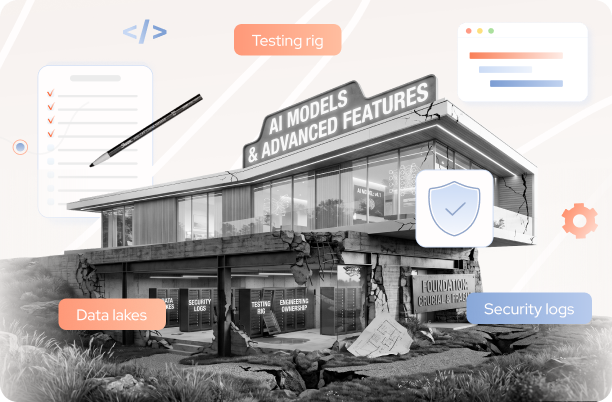
Many AI initiatives fail to scale for reasons that have little to do with the model. The real constraints often appear in existing applications, data flows, integrations, and operational processes.
Before expanding AI across departments, engineering teams need to understand whether the current environment can support additional workloads without constant rework.
An AI readiness assessment examines:
- Application and API readiness
- Data quality and accessibility
- Security and governance requirements
- Infrastructure scalability
- Operational ownership after deployment
Learn how to evaluate the technical foundation required for enterprise AI adoption in our AI readiness framework.
Benefits of AI modernization for businesses
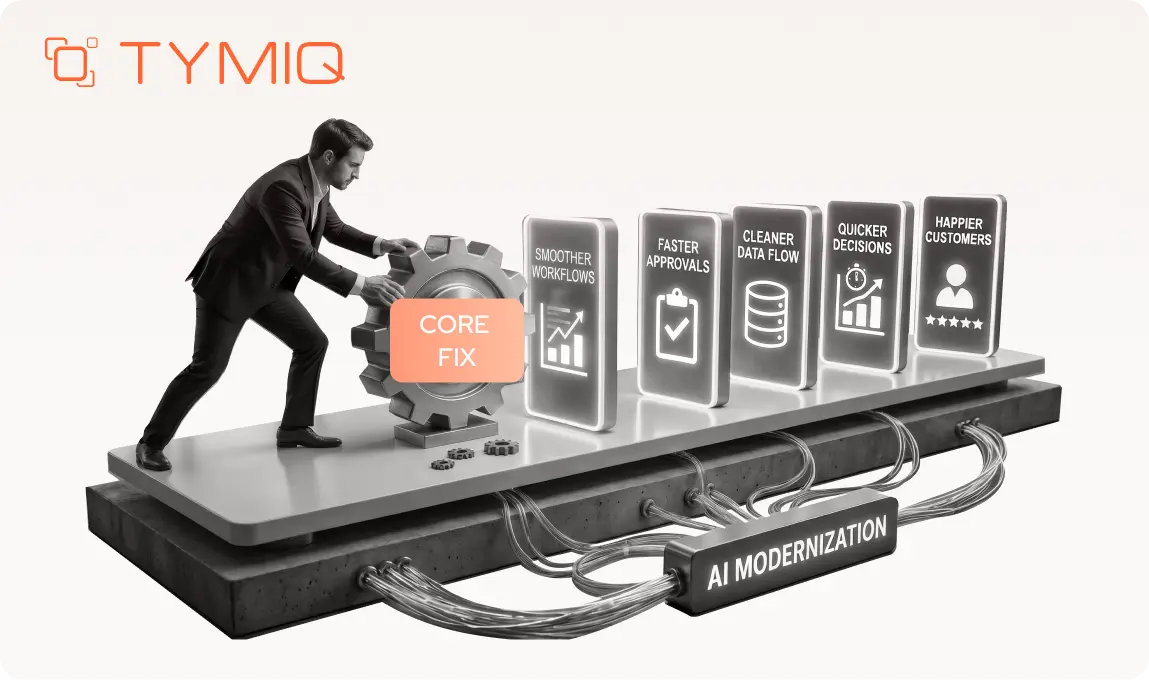
What businesses gain from AI modernization usually shows up gradually.
Teams spend less time chasing information. New ideas move from testing to production faster. Systems become easier to connect. Small operational slowdowns stop compounding across the business.
Some gains appear faster than others – let’s review the most noticeable ones.
Faster time-to-market
Modern systems make experimentation easier.
When APIs, connected data environments, and cloud infrastructure already exist, teams can launch copilots, automation workflows, or internal AI tools faster. What once required months of integration work may take weeks.
This matters because speed compounds. Teams test more ideas, learn faster, and adapt earlier.
According to Google Cloud’s 2026 State of AI Infrastructure findings, organizations with mature cloud and AI infrastructure were significantly more likely to move AI projects from experimentation into production.
Better access to organizational knowledge
One of the least discussed benefits of AI modernization is knowledge access.
Many organizations already have useful information. The problem is that it lives across emails, internal documentation, customer systems, reports, or disconnected applications.
Modernization helps create environments where teams can surface relevant information faster without manually searching across systems. This becomes especially useful for onboarding, customer support, internal operations, and documentation-heavy work.
More resilient operations
Businesses become more resilient when fewer processes depend on manual coordination.
61% of CEOs are already preparing for AI agents and large-scale automation, though many admit organizational complexity still slows execution.
In other words, many leaders are not just chasing efficiency. They are trying to build organizations that can respond faster, adapt more easily, and avoid getting stuck in operational slowdowns.
Faster decisions with less operational friction
Better decisions rarely come from more meetings.
They usually happen because teams spend less time collecting information.
Microsoft researchers analyzing 5.5 million enterprise AI interactions in 2026 found growing use of AI for writing, summarization, analysis, and decision support. Easier access to information helped reduce time spent on repetitive knowledge work.
In practice, the focus shifts as follows:
None of this removes decision-making from people. It changes how much time teams spend gathering context before decisions can happen.
Lower technical debt over time
Technical debt becomes noticeable when everyday work starts slowing down (we covered this topic in more detail earlier, though if you missed it, the article is worth a look).
A feature request that should take days turns into weeks because systems no longer communicate cleanly. Teams hesitate to update older applications, knowing one change can trigger problems elsewhere. Instead of building new capabilities, engineering time gets spent maintaining aging infrastructure.
This becomes an AI problem quickly. Most AI systems rely on APIs, reliable data access, and connected environments. In older systems, teams often fall back on manual workarounds, custom connectors, or duplicated data to make AI usable.
Incremental modernization helps remove those blockers without forcing a complete rebuild. Teams may modernize APIs, replace fragile integrations, move workloads to the cloud, or retire systems slowing progress. The result is fewer engineering bottlenecks and less effort getting new AI projects off the ground.
Of course, when the upside becomes clearer, most organizations want in. But before moving faster, though, it helps to make sure the foundations are solid.
Where AI makes the biggest difference
AI is becoming a regular part of modernization projects, though it doesn't contribute equally everywhere. Some tasks, like code discovery, documentation, dependency analysis, and test generation, are already well suited for AI. Others still depend on architectural judgment, business context, and decisions that go far beyond the code.
Across modernization projects, a few patterns stand out:
- AI performs best when technical outputs are easy to verify.
- Discovery and analysis often deliver bigger productivity gains than code generation.
- Business rules, architecture, and modernization strategy still rely on experienced engineers.
Want a practical breakdown? Our dedicated guide walks through seventeen common modernization activities and shows where AI already earns its place, and where architects continue to lead.
How to know if your business is ready for AI
Many organizations want to know where modernization should begin. In most cases, the answer comes down to readiness.
Before scaling AI, it helps to understand where friction already exists across systems, workflows, data, and governance. Deloitte’s 2026 State of AI in the Enterprise report found governance, workforce readiness, and operational integration remain among the biggest barriers to broader AI adoption.
Few organizations score equally across every area. Teams may have strong AI ambitions but struggle with fragmented data, legacy systems, or unclear ownership.
Before expanding AI investments, it helps to get a clearer picture of what may slow progress later. TYMIQ engineers often start with a short readiness assessment to spot gaps across systems, workflows, and governance early.
AI readiness assessment
The reality is, almost no organization scores strongly across every category.
AI adoption often slows because one technical bottleneck starts affecting multiple parts of the business. In some cases, fragmented or inconsistent data limits model accuracy and automation. In others, unclear governance delays approvals, while legacy systems with limited APIs or incompatible architectures make integrations harder to scale.
The core components of AI modernization
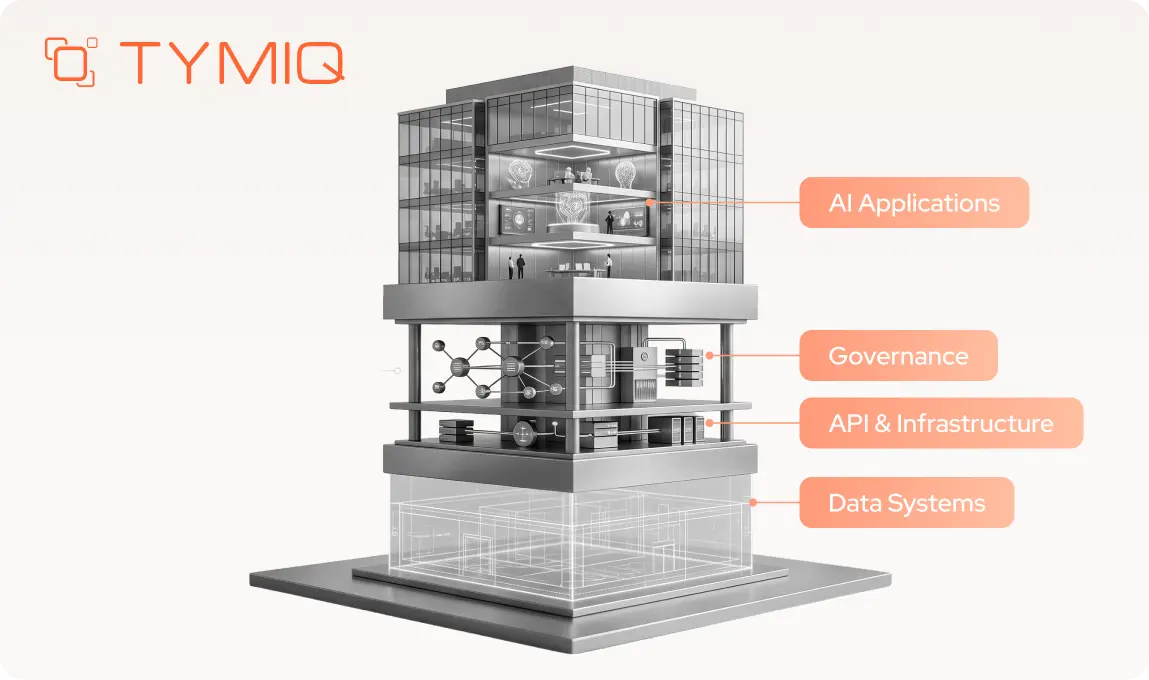
Buying AI tools and preparing a business for AI are two different things.
Many organizations expect technology upgrades to solve adoption problems. Progress usually depends on a mix of systems, workflows, governance, and operating practices working together.
1. Data modernization
AI systems depend on accessible and reliable information.
Disconnected data environments often slow implementation. Teams spend time cleaning spreadsheets, reconciling records, or manually preparing inputs.
Data modernization focuses on:
- Connecting siloed systems through APIs and shared data layers
- Improving data quality through standardization and deduplication
- Building pipelines for faster, more reliable data access
- Strengthening governance, permissions, and compliance controls
- Preparing data environments for AI models, analytics, and automation
Companies with stronger data maturity often move faster during implementation because fewer operational blockers appear later.
2. Application modernization
Could you run Doom on an old computer? Bad example. People somehow managed to run it on printers, ATMs, even pregnancy tests.
Modern LLMs are far less forgiving.
Legacy systems often struggle with the things AI depends on. A customer database may sit in one system, support tickets in another, and operational data somewhere else entirely. Older applications often lack modern APIs, event streaming, or integration layers needed to exchange information in real time. Many were built long before anyone expected systems to support AI copilots, retrieval pipelines, or autonomous workflows.
This creates a familiar hesitation inside teams. “Can we even connect this?” turns into “What happens if the data is wrong?” Before long, employees are exporting spreadsheets manually, checking outputs twice, and relying on workarounds because no one fully trusts the systems underneath.
3. Infrastructure modernization
AI workloads place different demands on infrastructure than traditional business software. Real-time inference, large-scale data processing, vector search, and automation workflows can quickly expose limits in older environments.
Many organizations are investing in cloud or hybrid infrastructure to support growing AI requirements, especially when existing systems struggle with performance, scalability, or latency.
Infrastructure modernization often includes:
- Cloud or hybrid migration for more flexible compute capacity
- GPU-ready environments for AI training and inference
- Scalable storage and faster data retrieval
- API gateways and orchestration layers for connected systems
- Security upgrades for access control, monitoring, and compliance
A useful example comes from Pinterest. In 2026, the company committed a staggering $4 billion to AWS infrastructure through 2031 to support AI-powered search, recommendations, and shopping experiences as demand for compute-intensive workloads increased.
The investment highlights a broader trend. AI adoption often pushes organizations to rethink infrastructure long before systems reach their limits.
4. Workflow modernization
Technology alone rarely improves operations. Many businesses still rely on approval chains, manual reporting, and repetitive administrative work that quietly slows execution.
The pressure is growing as AI moves deeper into day-to-day operations. McKinsey’s 2026 State of Organizations report found companies are paying far more attention to redesigning operating models, especially as AI starts changing how decisions are made, work gets coordinated, and teams collaborate. The report highlights a growing move toward flatter structures, fewer managerial layers, and workflows designed around faster execution and human-AI collaboration.
In practice, this can mean fewer manual approvals, shorter reporting cycles, or AI helping teams surface information before decisions become bottlenecks.
5. Governance and compliance
As AI adoption grows, governance stops being a side conversation and becomes part of day-to-day operations.
Organizations need clear rules around who can access AI systems, what data models can use, when human review is required, and how outputs are monitored. This becomes especially important once AI moves closer to customer interactions, financial decisions, healthcare workflows, or sensitive internal operations.
In practice, governance may include:
- Access controls for sensitive systems and data
- Approval processes for customer-facing AI use cases
- Audit trails and monitoring for AI-generated outputs
- Policies around privacy, security, and responsible AI use
- Human review for higher-risk decisions
As AI adoption grows, governance tends to move higher on the priority list. Deloitte notes that in 2026, many organizations still struggle to scale because trust, oversight, and compliance become harder to manage.
It stands to reason that companies addressing governance early often move faster over time, since they face fewer delays tied to security, legal reviews, or operational approvals.
How to build an AI modernization strategy

Many organizations begin with tools, but a stronger approach begins with business priorities.
In our experience at TYMIQ, AI modernization works best when teams stop thinking in terms of tools and start with operational problems. A slow onboarding process, disconnected customer data, approval bottlenecks, or rising support costs often become the reason modernization moves forward in the first place.
So where does all of this leave us? Let’s go step by step.
Assess readiness
Start with current reality.
Where do systems slow adoption? Which workflows create friction? What data limitations exist?
This step helps identify where modernization should begin.
Prioritize business outcomes
Organizations often struggle because goals remain vague.
Clearer priorities work better:
- Cut support resolution time
- Improve fraud detection precision
- Automate invoice and approval workflows
- Improve demand forecasting accuracy
- Reduce reporting delays across teams
- Shorten customer onboarding time
- Reduce manual data entry
- Simplify legacy system integrations
Identify modernization gaps
Once priorities are clear, organizations can identify blockers.
For some companies, data quality becomes the biggest limitation. Teams may pull customer information from multiple systems and end up working with conflicting records. In other cases, legacy applications make integrations difficult or compliance requirements slow deployment.
This stage matters because blockers tend to look different across organizations. PwC’s 2026 Digital Trends in Operations Survey found that 87% of operations leaders said poor data quality reduced value from digital initiatives, which helps explain why many modernization efforts start with systems and data before AI tools themselves.
The goal is not fixing everything at once. It is identifying which gaps are most likely to slow progress first.
Modernize selectively
Many organizations make one costly mistake: they try to modernize everything at once. However, incremental modernization often produces stronger results.
A business may modernize customer service systems first, then expand into operations, analytics, or internal copilots after early success. This approach reduces disruption and builds internal confidence.
Build governance early
Governance becomes harder to introduce after deployment expands.
Policies around customer data access, approval paths for customer-facing AI, accountability for model outputs, and monitoring practices for accuracy and compliance work best when introduced early.
Many organizations bring in outside support during this phase because modernization often touches infrastructure, security, workflows, and legacy systems at the same time.
A practical AI modernization roadmap
At TYMIQ, we see AI modernization as a sequencing challenge rather than a technology challenge.
Organizations rarely struggle because they lack ideas for AI. The harder question is what needs to change first so adoption can scale without creating friction elsewhere in the business.
In our experience, successful modernization tends to follow a similar pattern, which is why we use the roadmap below as a practical way to think about progress. Teams establish the right foundations, validate value through focused use cases, and expand only once systems, workflows, and governance are ready to support broader adoption. The pace varies by organization, but the overall progression is often more consistent than it first appears.
AI modernization roadmap
The roadmap looks different depending on where an organization is starting.
If you are seeing strong AI interest but pilots struggle to move beyond one team, start with an assessment. Data quality, integrations, or unclear ownership often create friction earlier than expected.
If teams already use AI tools but workflows still rely heavily on manual work, foundation improvements may matter more than new software. APIs, infrastructure, and connected systems often become the limiting factor.
If early use cases already show measurable value, the focus may shift toward scaling. Governance, workflow redesign, and workforce adoption usually become harder once AI expands across departments.
AI modernization services: build, buy, or partner?
At some stage, many organizations face a practical decision: should modernization happen internally, through external platforms, or with outside support?
The answer depends on complexity, internal expertise, and timelines.
In-house modernization may work for organizations with experienced engineering teams and mature technical capabilities.
Off-the-shelf platforms can speed up implementation for targeted use cases, especially around productivity or automation.
External AI modernization partners often help organizations dealing with:
- Complex legacy environments
- Fragmented data systems
- Governance requirements
- Application modernization needs
- Enterprise-scale adoption plans
Strong partners usually support readiness assessments, roadmap planning, integration work, and long-term implementation.
The goal is not outsourcing ownership. Internal teams still guide priorities and business direction.
External expertise often helps reduce delays and execution risks when modernization grows more complex.
Is your business ready for AI modernization?
By this point, one thing is usually clear: successful AI adoption depends on more than choosing the right tools. Systems need to exchange information reliably. Data has to be accessible and trustworthy. Workflows, governance, and infrastructure need to support how AI fits into day-to-day operations.
Most organizations do not modernize everything at once, and they rarely need to. The better starting point is understanding what slows progress today, whether that is fragmented systems, manual processes, weak integrations, or pilots struggling to move beyond one team. AI modernization works best when priorities stay connected to real operational problems people already feel.
If any of this sounds familiar, it may be a good time to compare notes with the TYMIQ team – we’re here to help.



.svg)


